• About

2wheels2travel

~ Self propelled journeys with reflection

2wheels2travel

Author Archives: 2wheels2travel

Back to Europe: More Ruminations

09 Sunday Jun 2024

Posted by 2wheels2travel in Bike Stuff, Philosophy, Preparation

≈ Leave a comment

Tags

amsterdam, cycling, europe, netherlands, new civilization, travel

Obviously, this Blog has become — not a real-time-travel-report of adventures on bikes — but a series of commentaries on Travel as Adult Continuing Education.  (Or, Adult Remedial Education, for those of us who are trying to learn more about Western Civilization before it’s too late …)

Pre-travel

Part of any anticipated adventure involves planning: where to go, where to stay; what to see; fellow travelers …   For this undertaking, we did another 2-part Tour-de-Joy.

(cf. Iberia …)

The first part was an instance of this Blog: a 1-week Bike-and-Barge trip around Amsterdam.  Our previous Bike-and-Barge trip (pre-Pandemic in 2017 with the Bicycle Adventure Club) was a 2-week trip from Paris to Bruges.  Great fun!  Hugely informative.

“We could organize a Bike-and-Barge trip, ourselves,” Joy enthused.  “We could contact Tripsite, and recruit some of our Atlanta biking buddies to join us!”

Even though biking in Atlanta is complicated by heat and hills, we have enough bike enthusiast friends to fill a cycling barge in the Netherlands!  Soon we had booked the entire (13 person) Zwaan for an 8-day tour: May 2 – 9.

Some people were fine with a 10-day trip — arrive a few days early; get adjusted to the time zone; see a few Amsterdam museums; do the tour; head back to Atlanta.   Some of us wanted to extend our European sojourn: another country / tour / adventure …

The second part of the travel for Joy and for me was a week in Rome: a chance for Joy to do research for her historical fiction novel about aspects of WW II in Rome: Mussolini and his mistress, Claretta Petacci, fictional characters from the Ghetto …)

A tale of two cities — literally.  The connection being that both were profoundly involved in the Second World War and efforts (or, lack of efforts) to live in peace with the global community; and in urban planning (or, lack of planning) to create cities in harmony with the natural world.

Planning v. Good Fortune

At the top of this Blog entry, I mentioned Western Civilization, but really, we have a global civilization in the 21stcentury.  To our surprise, the Nieuwe Kerk (New Church) which was just around the corner from our hotel had an extraordinary photo exhibit: “The Stories That Matter – exploring the issues and narratives shaping our world through the eyes of photojournalists and critical thinkers”.

People who study Western Civilization may think of churches as places of worship — a font of Christianity. But, not in the modern era:

For decades, De Nieuwe Kerk Amsterdam has been known for its high-profile exhibitions about art, photography, and inspiring individuals and cultures. With an average of 150,000 visitors a year, the church is one of the most popular exhibition venues in the Netherlands. It also plays a role of national significance, hosting royal ceremonies, official gatherings, and cultural events.

One of Amsterdam’s oldest and most impressive historical monuments, De Nieuwe Kerk is a place of inspiration, commemoration, and celebration at Dam Square, the heart of Amsterdam. https://www.nieuwekerk.nl/en/de-nieuwe-kerk/
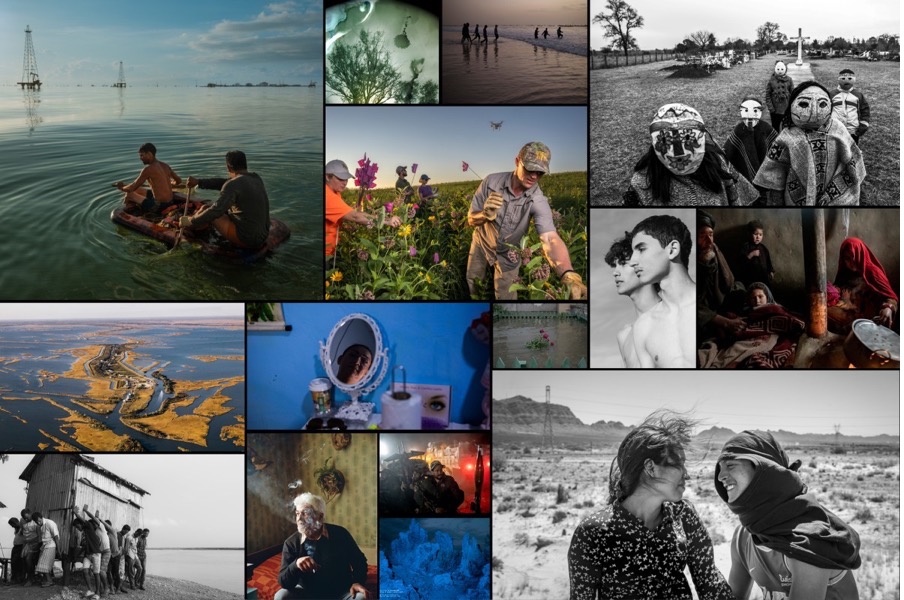
Given the theme: “The Stories That Matter,” much of the exhibition was images of war and economic injustice caused by climate change.

Extraordinary content for a building originally dedicated to the worship of God.  A fitting introduction to part of our Amsterdam experience: the Resistance Museum and the new Holocaust Museum. On our previous visit to Amsterdam, we visited the Anne Frank House — a memory that still reverberates. 

International flavor of Amsterdam: taxi driver from Uzbekistan; Spanish waitress in a Middle Eastern restaurant; a canal tour with two guides: Italian and Egyptian …  A Tapas restaurant …  And of course, a ‘n’course restaurant featuring Rijsttafel: The Dutch-Indonesian Rice Table.

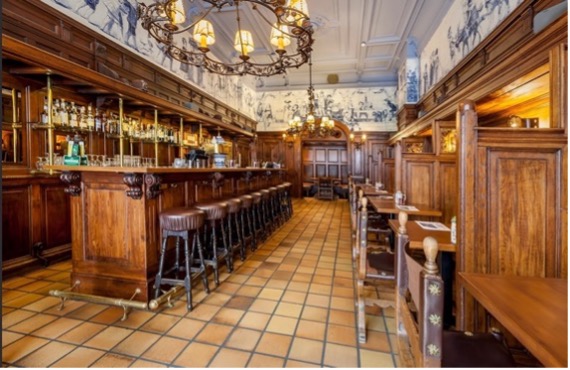
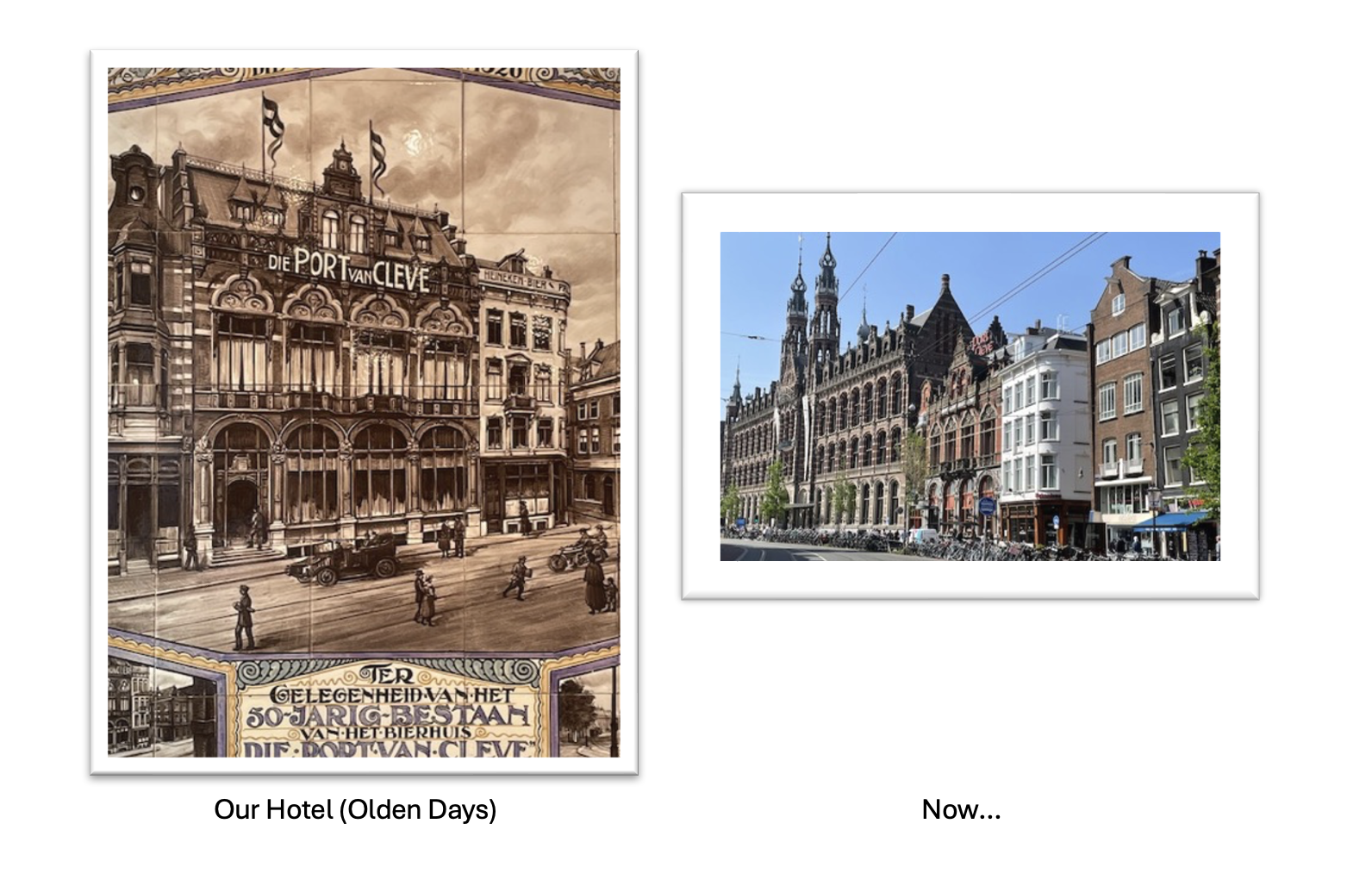
Our hotel, Die Port van Cleve, just off Dam Square, was a delight, celebrating its 150th anniversary.  Bar Bodega – de “Blauwe Parade” is a traditional Amsterdam bar full of tasteful beers, jenever, and history, including the largest Delft Blue tile tableau! 
Off to the Barge

More could be said about Urban Planning in a nation where 40% of the country is not just planned but created!  Build originally for pedestrians and floating vehicles, Amsterdam is now comfortable for the “15 Minute City” lifestyle: pedestrians, bikes (!), and functional public transportation.  Yes, there are automobiles, but mercifully few.

After checkout from our charming hotel, a relatively easy (with suitcases and backpacks!) tram ride to the Central Station.  (Hooray Rick Steves’ minimalist packing list.)

What should have been a relatively easy (with suitcases and backpacks!) walk to our barge was a bewildering mess …  Changes to pedestrian paths and ongoing construction confused Google Maps.  Ugh.  An astonishingly pricey taxi ride and presto — our new home for 8 days.

Good News:

  • Relatively spacious rooms (this is still a barge, but OK++);
  • Clear orientation to the process of Not Getting Lost with just a guide and NO sweep;
    (details below …)
  • Clean helmets and panniers, new water bottles, 
  • Charming crew;
  • Short orientation ride after short barge journey to rural biking spot ;

Bad News:

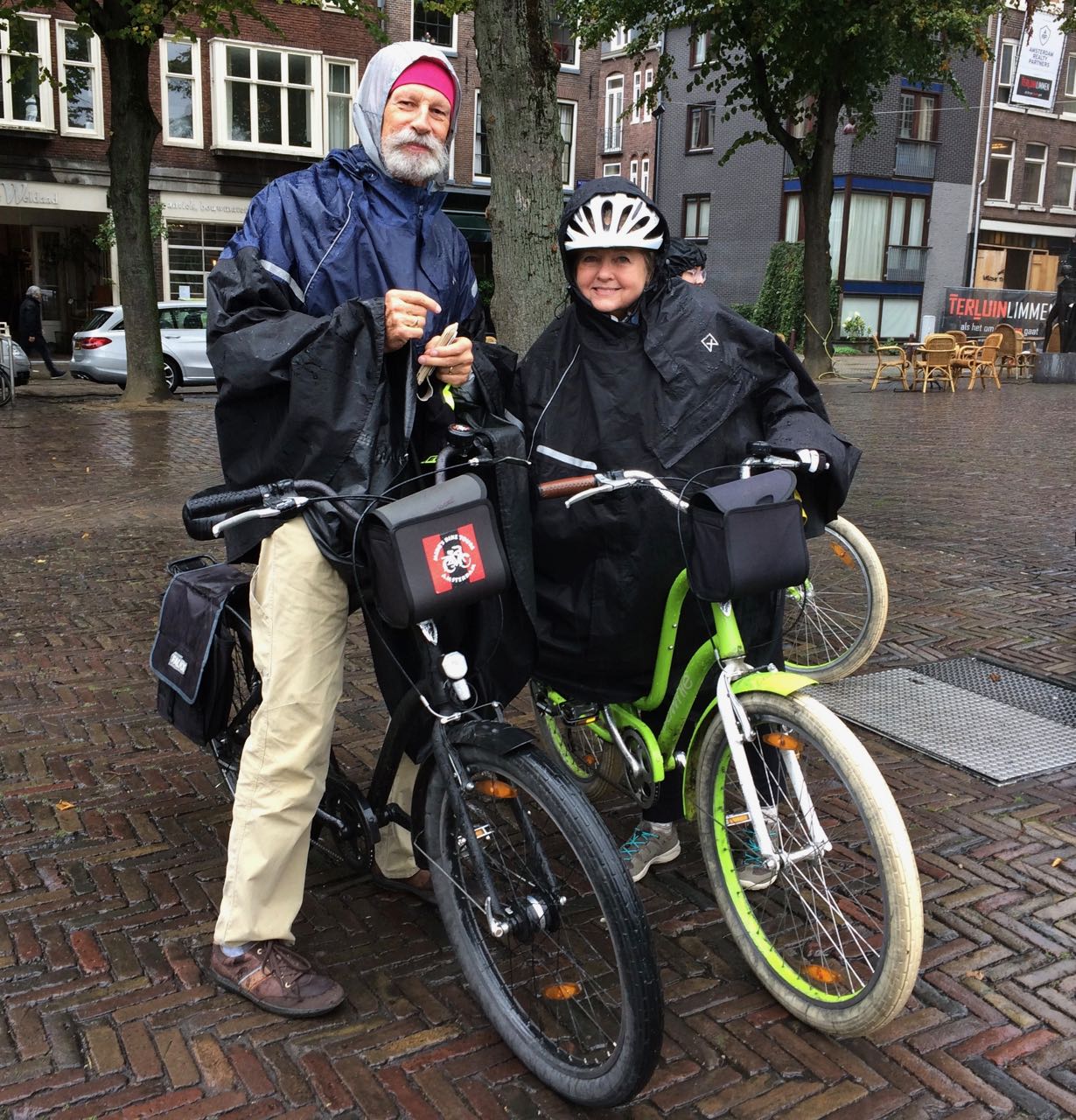
  • Dutch-style bikes.

On our previous Bike-n-Barge trip, the bikes had been US-style hybrids.  Seat and handlebars at approximately the same height.  A familiar forward lean.

Dutch-style bikes force the rider into a much more upright position.  Higher handlebars with flared back grips.

Turning a bike that has a unique configuration is a learned behavior.  How much time to learn a new set of reflexive moves?  I don’t know.  It’s not a binary transition — one improves over time.  But the need to learn quickly was apparent on the first day. 

Although most rural roads are straight, they are quite narrow.  (Remember, almost every square centimeter of land was created with significant effort.)

Although these narrow roads would be one-way-only in the US, they are actually two-way traffic throughfares. (Throughfares for bikes and motor scooters and a few motorcycles.)  Which means, when you see oncoming traffic, you need to get the wheels of your bike as close as possible to the right shoulder of the path, quickly.

And of course, if someone is passing you (think motor scooter or motorcycle or Dutch bicycle rider), you need to move all the way to the right-hand edge of the narrow path, quickly.

And, beyond worrying about the edge of the path (usually wet grass, sloping down to the water in the canal), there was a question as to the Goldilocks’ space behind the bike in front of you.  Too close and you crash if the person in front stops quickly.  Too far and you may be all alone after a turn …

So, since this is — originally, a bike Blog — it’s time to explain the trick to Not Getting Lost with just a guide and without an experienced sweep who knew the route (technique on our first Bike-n-Barge trip).  Yes, there was a sweep, but that person was one of us, a new volunteer each day.  And that person stayed at the back of the line of riders.

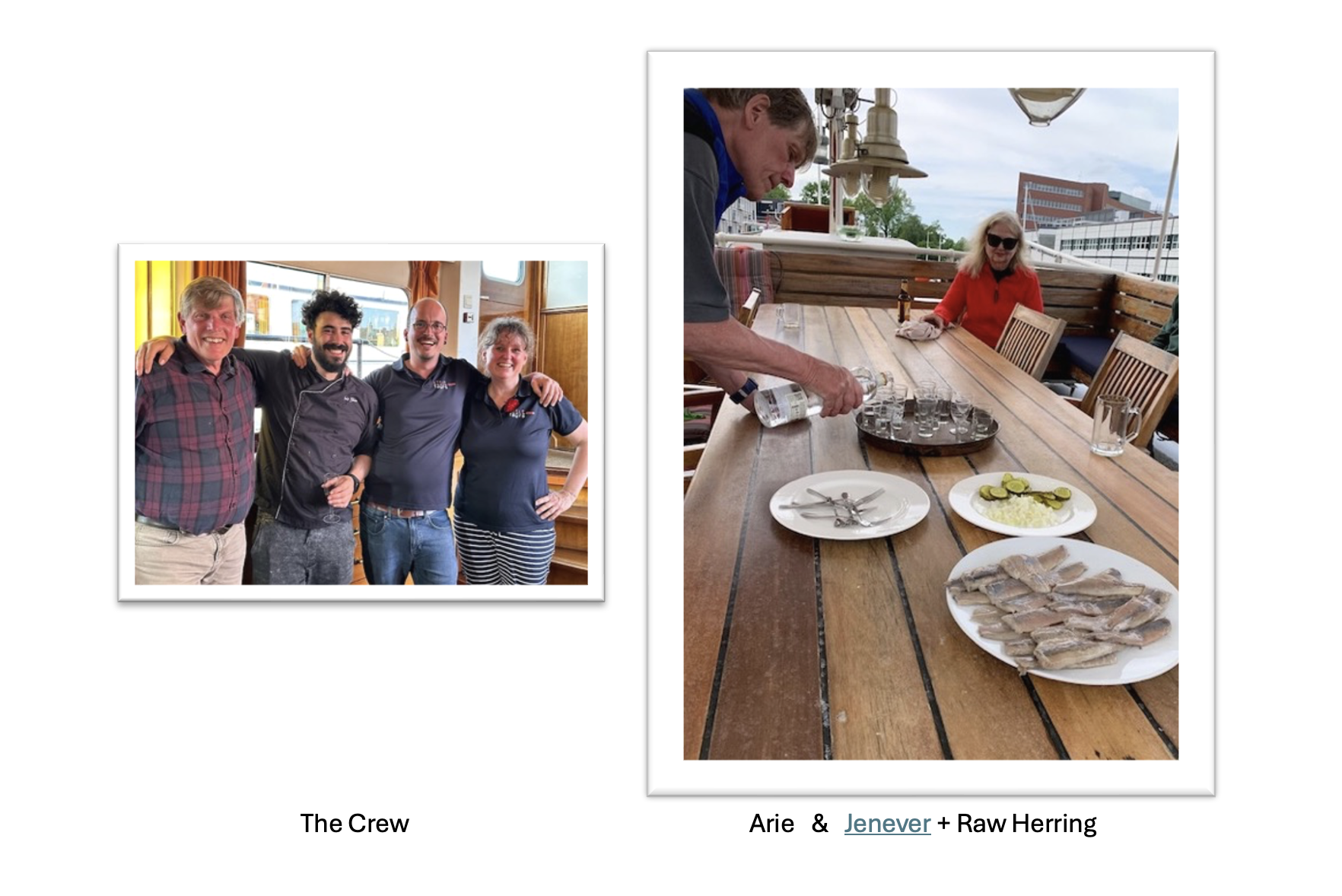
At each turn in the road, (actual left/right turn, fork in the road, intersection within a roundabout …), Arie, the guide would yell “Corner.”

The person behind him would stop and point out the direction of travel to each subsequent rider, until the sweep appeared.  Then, he/she would become the next-to-the-last rider in the pack, just in front of the sweep.

Throughout each ride, each of us would move closer to the front, and — usually — become a Corner at some point.  (On a day of dense navigation in urban areas, you could be a Corner more than once.)

The technique worked reasonably well.  Especially after the first day, when there was some confusion about who the sweep really was: the person who volunteered, or the person whom Arie had designated.

Despite some days with an attenuated line of riders, no one became lost or abandoned.  But, as with any form of travel, dynamic changes (construction / washed out canal segments …), last month’s route may not work today.  So, Arie used the GPS function of his phone and conversations with local folks to refine our path as he went.  (So much for Cue Sheets for independent-minded bikers.)

On a conceptual level, the “Corner” technique reminds us of the nature of community: we are all each other’s helper; we need to perform social guidance roles as needed — the Golden Rule for a bike Peloton in a novel locale.

So, What Did We See?

We, is an interesting pronoun.  Just as this idiosyncratic recollection is unique, each person had — I suspect — a separate experience.  Partly, a result of How Many Days Riding.

Some people rode all 7 days.  I rode 5.  Joy rode 4.  One person rode 2.  

Partly, a result of How Many Falls.  Remember, Dutch bikes with a demanding learning curve.

Some of us did not fall.  (Applause, as I pat myself on the back …)  Some had 1 spill.  One person had 3 minor crashes.  She was the person who rode just two days.  Combining all the various mishaps: 10 falls.  Significantly more than the average tour.

We all saw, no matter our degree of cycling, a verdant, nation, extending into the North Sea, through brilliant hydraulic engineering and common purpose.  A nation, more diverse in Amsterdam than in the small towns.  A nation without apparent poverty, having transitioned from a mighty colonial power to a prosperous modern nation with an educated population.  

I was too busy to post on Facebook (I don’t do that anyway; I occasionally post on Instagram), but again, too busy …  And, even with okay Wi-Fi on board, no Blog posts.

Much more interesting to spend time chatting with fellow riders, enjoying great food (a Scottish cook, who shopped the local markets each day!), good wine, and local beer — plus haunting memories of the Resistance Museum.

The Nazis were not tourists in the Second World War.  And, the Dutch, with a still strong global economy,  knew that by selectively flooding parts of their country, they could prevent the influx of Panzer tanks and Hitler’s infantry.  They had not conceived of hordes of paratroopers.  

They were confronted, like most of Europe, with horrible choices during the time of occupation.  The Resistance Museum provides context and an inspirational view of the sacrifices made by many valiant people in the Netherlands.
On the Canals

Classic:

Credit: John Underwood

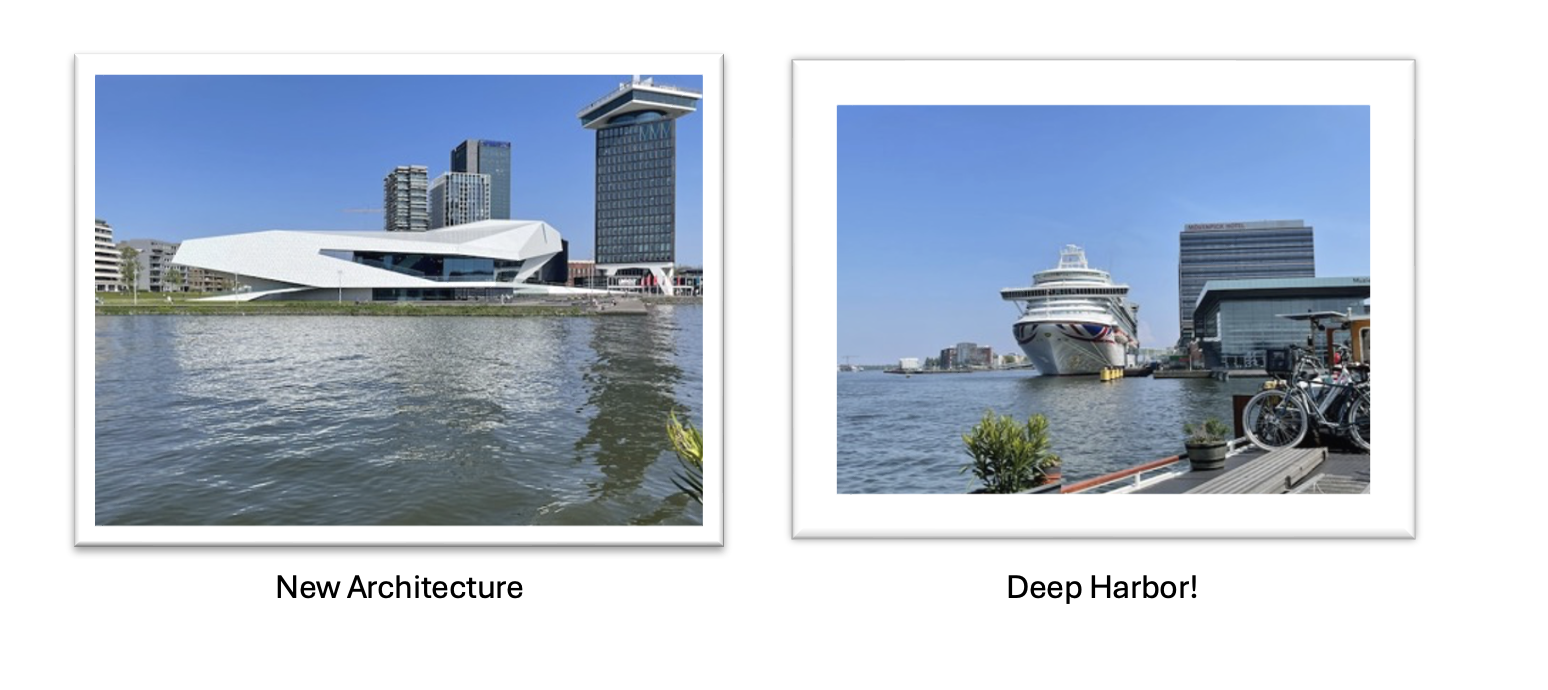
As Our Barge Traverses the Harbor

Day 2 — a rest day for some
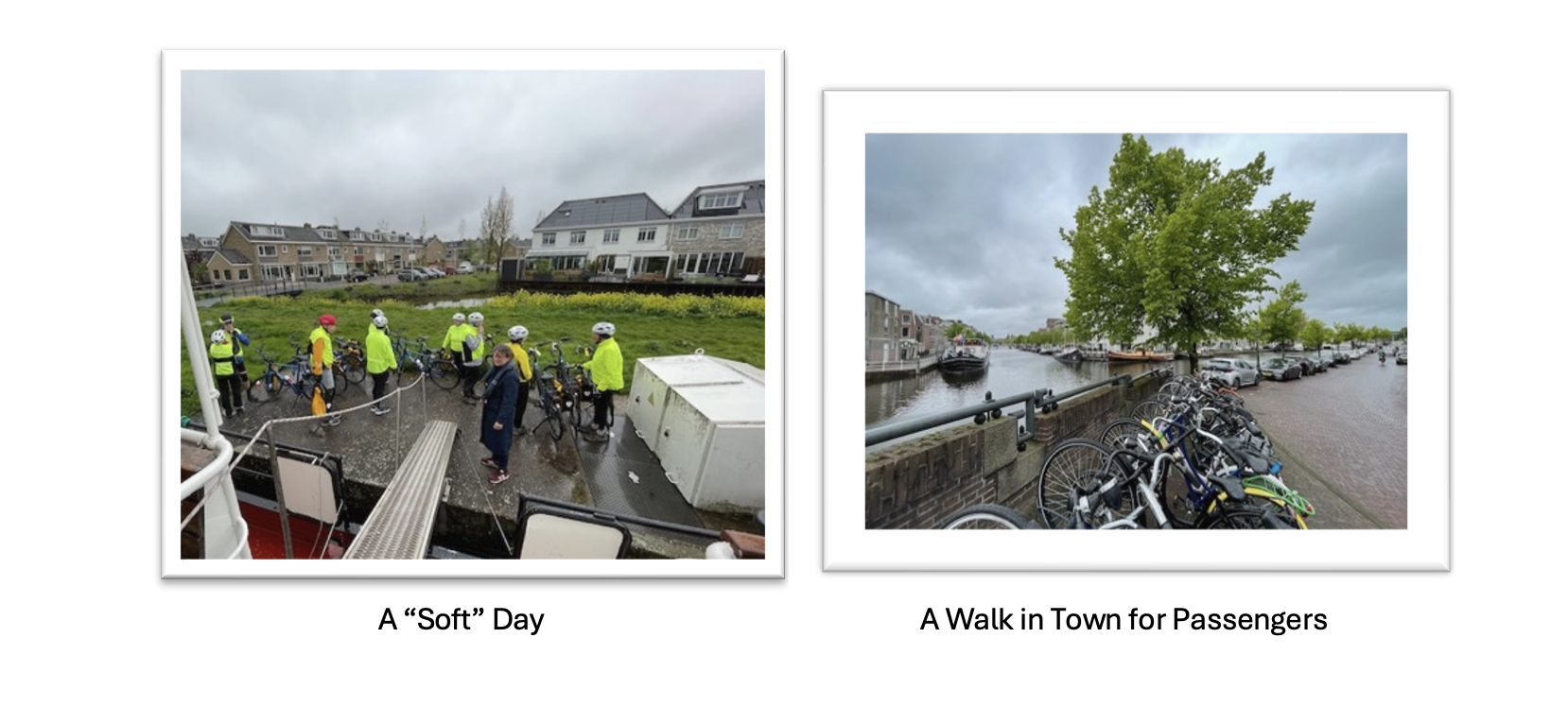
Day 3 — the countryside

Break Time
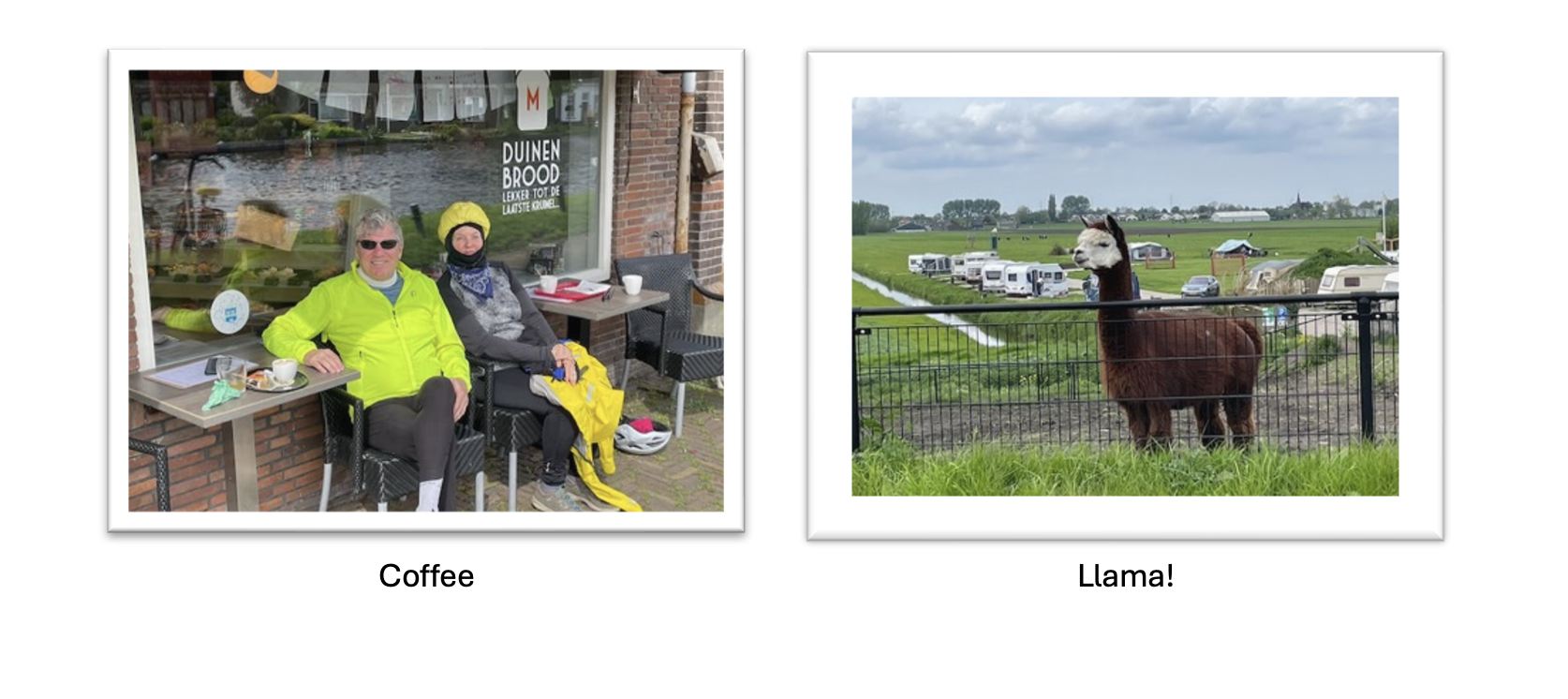
Lunch Break 
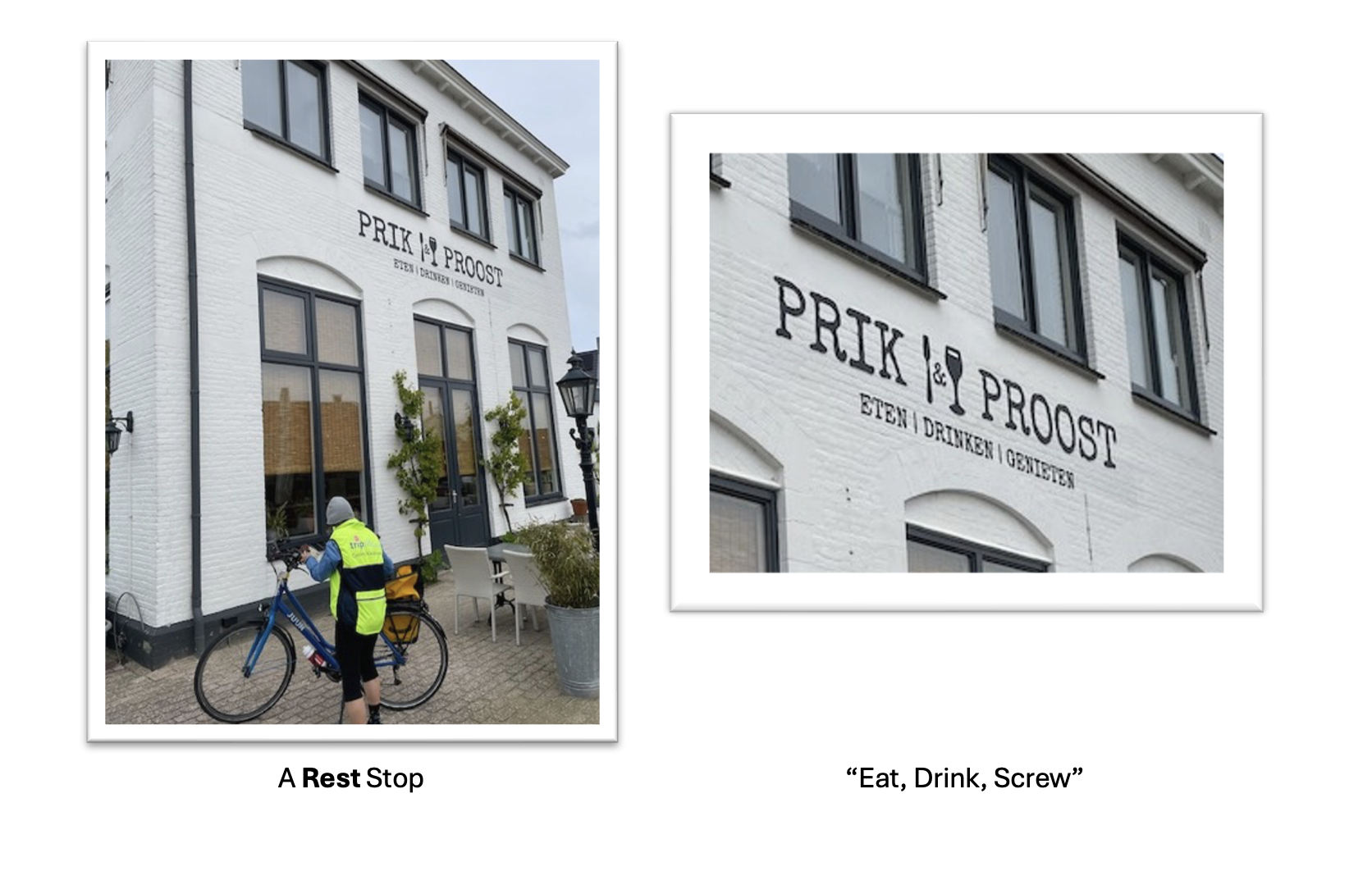
Oh, yes — Fields of Tulips

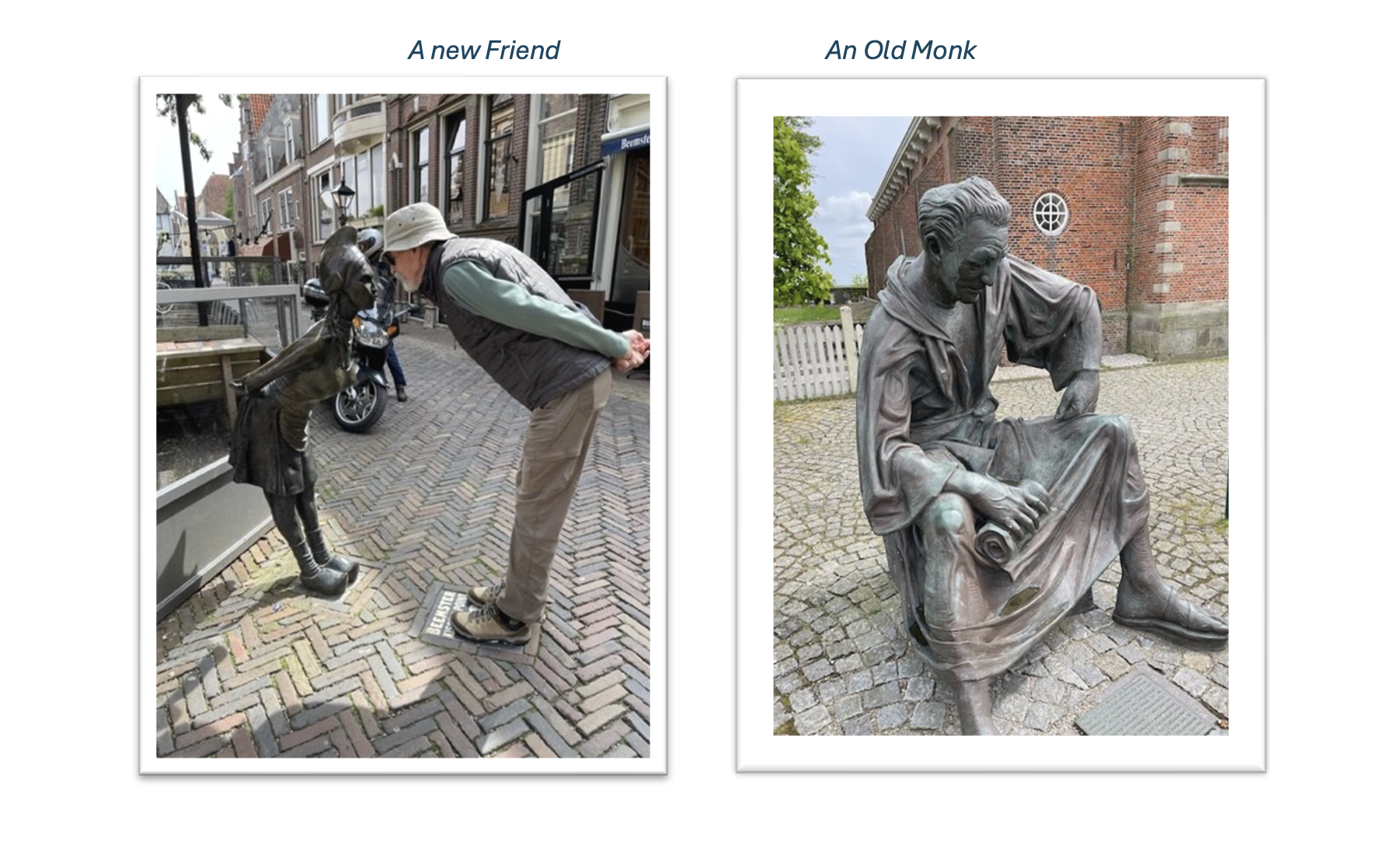
Dutch Sculpture

…more Sculpture
Snippets from the Barge

A last Breath of Salty Dutch Air
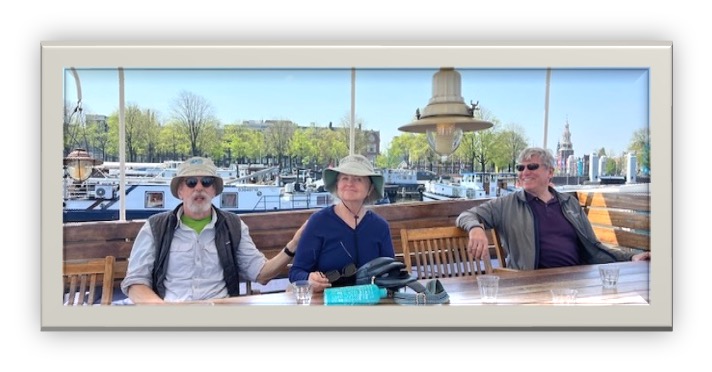
A Research Endeavor: a Catalyst for Reflection

Our previous trips to Italy had been a bike ride with The Bicycle Adventure Club (2012) and (2014) a chance to see Florence (beyond breath-taking), plus a remote resort in southern Italy.  (Why is the South always the most unsophisticated part of any country?).

Rome had been merely a city with an airport, the Vatican (yes, I was raised Catholic), and the worst traffic in any disorderly urban bedlam.

This time, Rome was our destination — specifically parts of Rome which are locations within Joy’s new novel, including the Jewish Ghetto with its monumental Tempio Maggiore — The Great Synagogue of Rome.

Built in 1904 (design by Vincenzo Costa and Osvaldo Armanni), its lowest level now contains the Museo Ebraico di Roma — an astonishing collection of scrolls and artifacts.

We did classic tourist hustle and bustle: a tour of the Colosseum; a tour of the Pantheon.  They were reminders of excellence in architecture, engineering, and entertaining the deplorables.

From our guest house accommodations (“Remember, this is not a hotel; use the link to activate the door …”) we wandered to extraordinary local restaurants each evening.  Yes, Yelp works quite well in Rome!

Not a hotel!

Colosseum             [link]

Pantheon                 [link]

Tourists in Warm Rome, not chilly Netherlands

A long Time Ago …

The Center of the Ghetto Tour
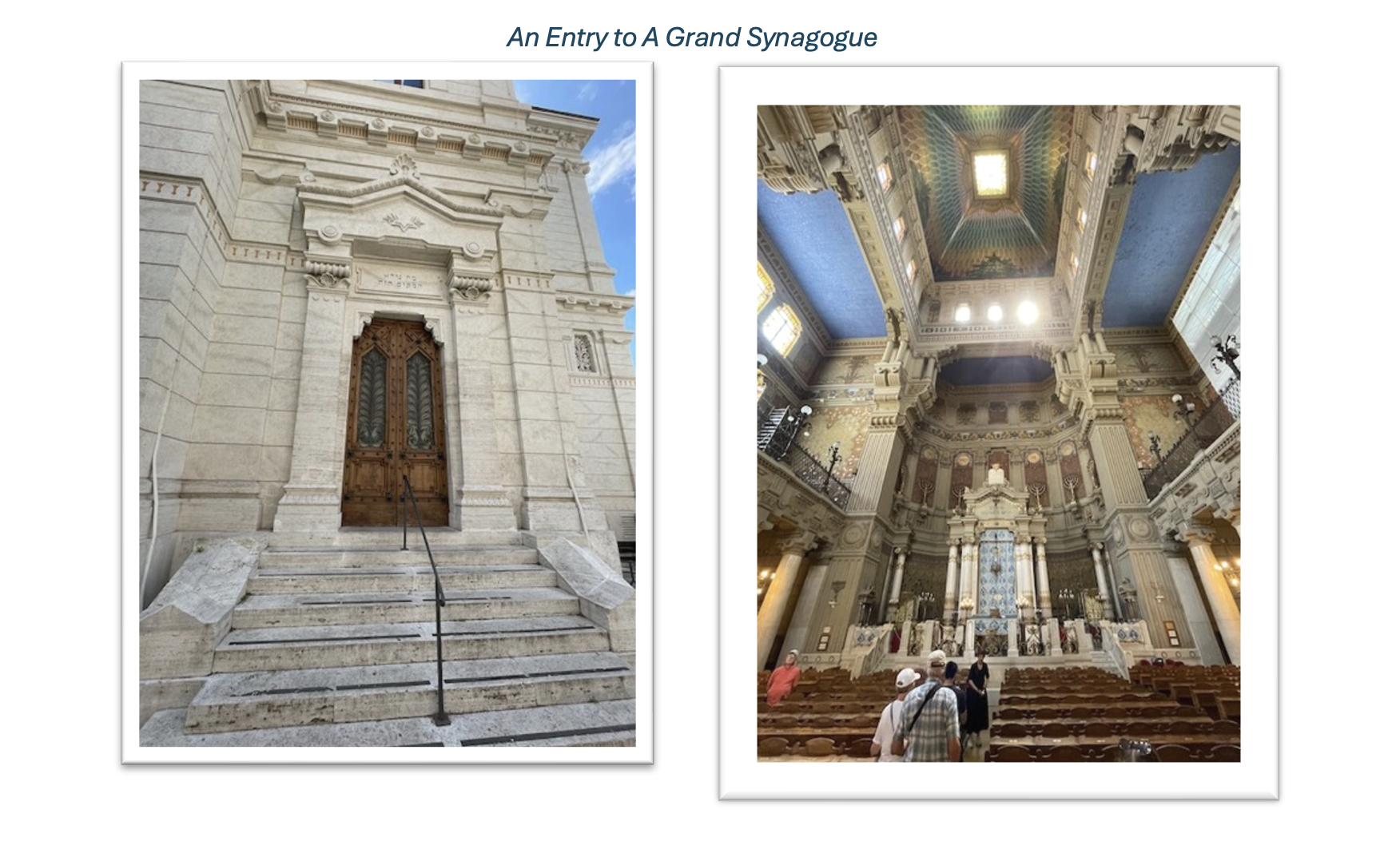
In one small restaurant we could not help but hear snippets of conversation at the next table: a mature woman and a younger man — speaking to the waitress in Italian and in English.  But, speaking to each other in neither language.  Eventually, we found a way to strike up a conversation and discovered that the young man was the son of the Israeli woman, who was visiting to see how his studies in medical school in Rome were progressing.  And, I suspect, to escape the chaos and rancor at home.  Of course, their other language was Hebrew.  After hearing about Joy’s book, they offered to help arrange a visit to the Great Synagogue.  Not necessary, it turned out.
 
It was not our only contact with Hebrew: after our guided Ghetto tour, we decided to stay and find a place for lunch: “Would you like a menu in English or Hebrew?” the waitress asked (in English).  I forget the name of the restaurant, but not the establishment next door — the place selling bagels and baguettes — Ba’Ghetto.
 
Still contemplating the Resistance Museum in Amsterdam, still fearing the trajectory of current U.S. political drift, the physical reality of the current Ghetto is a stark reminder of what can go horribly wrong in the 21stcentury.

What To Do with Extraordinary Wealth 

The burgeoning Roman Empire predates the colonial juggernaut of the Netherlands.  And, the degenerations of that once-great power were, undoubtedly, a catalyst for Mussolini’s endeavor to Make Rome Great Again. Instead of merely bolstering the education system and reminding citizens of a time of great architecture, engineering, and colonial domination, he borrowed money from international lenders to: make the trains run on time; clean the accumulated debris from Rome; and use his Fascist military to reconquer the lands of the old empire.  His popularity was partly based on restoration of early Roman monuments and housing for urban peasants.

Today, though shorn of their marble façades, both the Colosseum and the Pantheon still stand.  However, much of the splendor and civic engagement of the Roman Forum is gone.  

The spirit of adventure and death-defying valor are now mostly evident in the tumult of the chaotic traffic.

As my biking sojourns in Europe suggest, the ebb and flow of civilization continues.  Some physical monuments endure — some fragments of civilizing mastery remain.  However, much has been lost: not the technology, not the distillation of philosophy, not the structure of institutions of learning and governance. 

What has been lost is the awareness of the universal application of the Golden Rule.  Peace is not merely the absence of war — it is the clear-eyed observation of the essence of the Torah from Rabbi Hillel:

He quoted from Leviticus, saying, “Thou shalt not avenge, nor bear any grudge against the children of thy people, but thou shalt love thy neighbour as thyself.” Hillel then concluded: “That which is hateful unto you, do not do to your neighbor. This is the whole of the Torah; the rest is commentary.”

Celluloid nostalgia can overtake us — in our selfishness, we try to look back to a golden age — and we are filled with sorrow:

A sorrow’s crown of sorrow is remembering happier times.

  • Alfred Lord Tennyson

Our sorrow should be that we have lost Hillel’s wisdom — and like the people of the Netherlands during the occupation, we may be faced with horrific decisions.
Why BLOG?

11 Monday Dec 2023

Posted by 2wheels2travel in Philosophy, Uncategorized

≈ Leave a comment

Tags

article, dreams, Food, new civilization, virtual-school

In my previous post (Why Travel?  (Version 2), I suggested that travel is a form of education.  However, as we age, the need to go somewhere else to gain new understanding seems less compelling.  Not that we know everything — but the wisdom of later years seems more a result of the integration of knowledge than the accumulation of more experiences.

And with a fiber-optic connection to the Internet, the world cascades upon us through various screens.  Some glittering rectangles occupy huge segments of an entire wall.   

As a former teacher and, in the later part of my career, an information architect, I view tourism as a variant of a well-designed educational interface.

As with education, there is a preparatory phase, an actual learning event, and a post-event review / test.

For me, the preparatory phase of travel is reading.  Indeed, reading about this new somewhere else can be a profound catalyst for insight.

The actual event of travel, if it includes a guide, can have the feel of a brilliant lecture with astonishing 3D visuals.

If one travels with a notebook and a camera (we all now carry a camera with a virtually limitless roll of film), there are recordings of the lecture to review.  This review process may inspire more research when we have returned from somewhere else.

[I have a framed quote in my office (a relic from my teaching days).  It reads:
“To teach is to learn twice.”]

Creating a BLOG post is a way to re-experience travel — to travel twice.

It is a literal review and an effort to do what we older folks often do while ruminating: connect the dots …

If you have read the previous post, you know that this overwhelming trip was not a bike ride.  It was a three-part odyssey where the catalyst for the trip to Europe vanished after our plans were made, and after deposits (non-refundable) were paid.  Follow links below for all three sections.

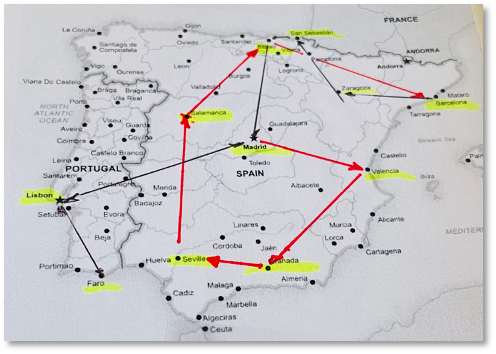
Part 1:                    Gate 1                 Two-week Guided tour of Spain

Includes                  Flamenco Movie

Map of Spain and route
  • Madrid
  • Toledo:
  • Valencia:
  • Granada: Post-1492 insight.
  • Sevilla: A Shared Appreciation of Abraham; A Shared Approach To Architecture
  • Salamanca:
  • Bilbao:
  • San Sebastian:
  • Toward Barcelona:
  • Barcelona: Land of 1992 Olympics and Gaudi
  • Tour of Torres Winery!

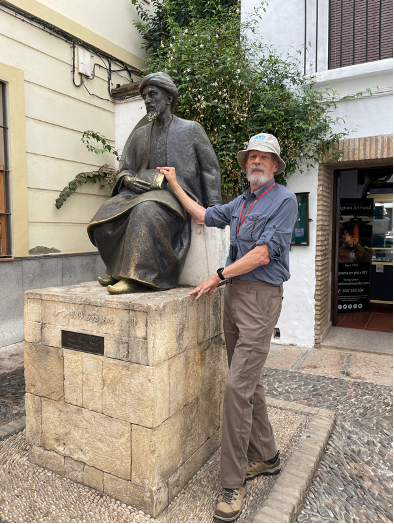
A moment with my buddy, Maimonides

(I read his philosophy in Spanish as a Middlebury undergraduate)
He is emblematic of a civilized era before the:

  • Reconquista
  • Inquisition
  • Creation of extreme wealth by colonialism

Part 2:    Roll-Your-Own    10-day self-guided tour of Spain & Lisbon

Includes                  Fado music Movie

  • The Tour de Joy — sans Clarissa
  • Barcelona
  • Zaragoza
  • San Sebastian …
  • Bilbao
  • Basque culture through a wineglass
  • more Bilbao
  • Madrid
  • Last night’s dreams: Thich Nhat Hanh:
  • Madrid -> Lisbon
  • Lisbon
  • Lisbon -> Faro…

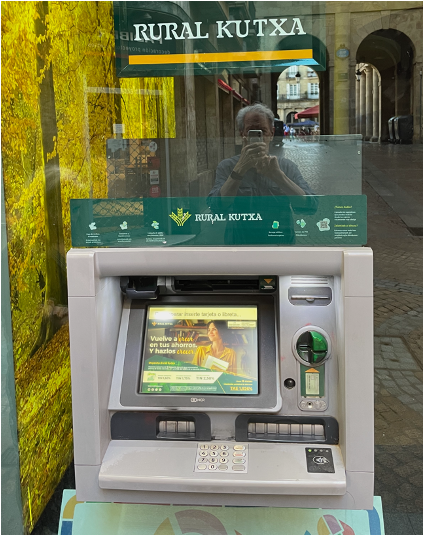
Is the ATM of a Basque Credit Union really connected to the International Banking System?
Would it recapture a US Debit Card?

Would that feel like a Jew or a Muslim experiencing the Reconquista?

Part 3:     Yoga                  One-week Yoga retreat in Portugal

Sea to See…           A summary of a few days in Paradise:

Our Fearless Leader, Trã — and Joy

The theme of exploration has been a catalyst for sundry inward meanings as the yoga classes have continued — and as our conversations have ventured past mere pleasantries.  

In Portugal, the explorations of Vasco da Gama are still quite real.

When is the edge a good time to stop?  

When is the edge a good time to extend one’s effort?  

Even after 80 years, new insights can be forged in the crucible of extended travel.

Why Travel?  (Version 2)

01 Friday Sep 2023

Posted by 2wheels2travel in Philosophy, Uncategorized

≈ 1 Comment

Tags

new civilization

A glimpse into the past.

My previous post, in 2018 — which now seems a different era — was titled: “Why Travel?”

I observed:

In the PBS travel programs by Rick Steves, the opening introduction says that travel, like Public Television, enables us to develop a deeper understanding of our world.  And, at its best, travel changes us for the better. 

The implication is that travel propels us to experience great art, music, history, food, and people.   Our insights, like Rick’s, will enrich our lives.  

On Rick’s site:

“Travel is freedom… one of the last great sources of legal adventure. Travel is intensified living, with maximum thrills per minute. It’s recess, and we need it.”

Some thoughts for the present moment

For me, the past five years have been frightfully intense.  More “thrills per minute” than I needed as I watched medical science and political discourse implode.

In 2023, the year of  my 80th birthday, as I sense the impending disintegration of the Anthropocene epoch, as I experience the long tail of the pandemic and frantic efforts to forestall The Sixth Extinction (published: 2015), the reasons for travel seem quite different. 

My comfortable home in the Atlanta area has great art, music, history, food, and many wonderful friends. The High Museum, a symphony, an opera company, the vivid history of a Southern city, and (finally, post-1996) the ethnic restaurants and markets of an international city.  

Although I’ve done some consulting since leaving a full-time job in 2008, much of retirement is recess — every day.  And, by supplementing the rich reality of a metropolitan area of more than 5 million people with a fiber-optic cable, the virtual world can stream into my home on many glowing rectangles.

As the pandemic fades, a catalyst inspires a return to Europe.

“My husband and I are moving to Portugal,” Clarissa said, “you’ll have to stay with us a while in Lisbon.”  

“Oh,” my wife said, “how wonderful.”

 Joy’s old friend was enthusiastic about a move to Europe.  She and her husband had spent time in the suburbs of Lisbon and had both found opportunities there to enhance their careers with employment in Portugal — a fascinating vocational bit of luck.  

“Ah ha,” my wife said, “Our favorite yoga instructor is offering a retreat in Portugal at the end of September — pure synchronicity.”  

“We can have an engaging vacation — a personal introduction to Lisbon and a moment of regeneration on the beach.”

“And, as long as we have purchased tickets to Europe, let’s see if there’s a tour of Spain in that time frame.”  (Spain has been on my bucket list for years: my second language (a distant second) is español.

Soon we had a plan.  Not cheap, but a trip to Europe to see much of Spain (2-week tour with Gate 1), a week in Lisbon (possibly with Clarissa and her husband), and a yoga retreat in Faro, Portugal.  A few days for our own exploration along the way.  

…

By the time we had booked the Gate 1 tour, the yoga retreat, and airline tickets to and from Madrid, our catalyst vanished: “We’ve decided not to move overseas,” Clarissa announced one afternoon.

One of the core beliefs of Buddhism is the impermanence of existence.  Change and flux are omnipresent.  Even if it’s not “old age, sickness, and death,” something is bound to happen.  Especially if you plan to enjoy Rick’s “maximum thrills per minute” travel approach.

And I did not see a box anywhere on the Travel Insurance Form — 

       Trip canceled because relatives wimped out.

So, we decided to craft our own 10-day tour of Spain and Portugal between structured activities.  Which cities to visit?  Why those?  How to travel from City-1 to City-2?  Where to stay?  What to see / experience / encounter?

Where would we find great art, music, history, food, and people to transform our drab lives into the thrilling, exhilarating adventure of a lifetime?  And what might be the cost of those transformative adventures?   

“Let’s make a list,” Joy enthusiastically opined.

If we had known a great travel agent with a deep knowledge of the Iberian Peninsula (do such people still exist?), and we had had a free afternoon, perhaps this would have been easy.  But we knew no such person.

Of course, we have computers and mobile phones…  How hard could this be?  

After many iterations, we had a plan — the summary document is 8 pages long — with entries like this:

Mon, 04 Sep 2023

Catalonia Atocha, Madrid, Spain 
Standard Room with Breakfast More Info

1 Double Room / 2 Nights

Tue, 05 Sep 2023

Toledo Tour More Info

2 Adults

dinner on your own… 

Wed, 06 Sep 2023

Hotel Valencia Center, Valencia, Spain 
Standard Room with Breakfast & Dinner More Info

1 Double Room / 1 Night

It included all three tours:

  1. Gate 1 in Spain
  2. Roll Your Own Hand-crafted Tour of Spain and Portugal 
  3. Yoga Retreat in Portugal

The supporting documents are a thick stack of receipts — “Your stay is confirmed; reservation number: 2345678…”  “Show this QR-code at the train station…”   

You can guess how many hours, how many receipts, how many glasses of wine, how much money…  (Now, double your guesses.)

We are now done.  Well, we are done planning.  There are always the last-minute details, the packing, the photocopies of vital documents…  We finished paying for Travel Insurance…

But the question still lingers:
Why Are We Spending This Much Time and Money on Travel?

Will we really have the thrilling, transformative adventure of a lifetime?  Probably not.  Will I occasionally miss the peace and quiet of a lovely home where I can continue to work on a memoir?  Probably yes.  

But real life in a unique part of the world does (I must admit) create insights for the attentive observer.  Watching Rick Steves admire the sculptures of Michelangelo is quite different from an encounter with the works of a master artist in the galleries of Florence.  Skiing in the Rocky Mountains of Canada is quite different from appreciating pictures of snow-covered mountains.

And, trying to get biking directions from a small town in northern Italy to the next town (when no one speaks English) is an adventure.  (When we got lost, veteran riders of the Bicycle Adventure Club would occasionally observe that: “Adventure is our middle name…”)

For those of us with a somewhat lower level of tolerance for adventure, not all such events are enjoyable (in the moment).  But perhaps there is a Nietzsche-esque element to travel: “That which does not kill us outright, merely serves to strengthen us.”

I think he also said; “All great things must first wear terrifying and monstrous masks in order to inscribe themselves on the hearts of humanity.”

At 80, terrifying and monstrous are not my favorite perceptions, but I may learn something.

…

Preparations Beyond Packing and Crafting an Itinerary.

Does creating expectations help?  Yes and No.

Expectations can open the door to disappointment and frustration.  But anticipation can also prime the senses for how to absorb the newness of food with unique spices, wine with inimitable tannins, answers to questions about the flow of history, and a context for present-day events in the good ol’ U.S.A.

In my previous post I mentioned:

The audiobook version of The Swerve: How the World Became Modern by Stephen Greenblatt is “both an innovative work of history and a thrilling story of discovery, in which one manuscript, plucked from a thousand years of neglect, changed the course of human thought and made possible the world as we know it.”  [Amazon link]

The Amazon review includes:

“Nearly six hundred years ago, a short, genial, cannily alert man in his late 30s took a very old manuscript off a library shelf, saw with excitement what he had discovered, and ordered that it be copied. That book was the last surviving manuscript of an ancient Roman philosophical epic by Lucretius—a beautiful poem containing the most dangerous ideas: that the universe functioned without the aid of gods, that religious fear was damaging to human life, and that matter was made up of very small particles in eternal motion, colliding and swerving in new directions.”

The philosophical epic by Lucretius was “On the Nature of Things” (50 B.C.E), and the cannily alert man in his late 30s was Poggio Bracciolini.

In 2023, as I continue my inquiry into how the world is — and, how it might be — I once again encounter Poggio, as Greenblatt calls him.  This year I am reading Humanly Possible: Seven Hundred Years of Humanist Freethinking, Inquiry, and Hope,” by Sarah Bakewell. [Amazon link]  

Bakewell, too, is exploring those dangerous ideas: the origins and core beliefs of secular humanism.  She traces the roots of open-minded inquiry to Poggio and his contemporaries: Petrarch and Giovanni Boccaccio.  Like Poggio, they were aware that their age was a degraded version of an unrivaled time.  They knew the history of Rome’s ascendency and collapse.  They knew that the underpinnings of civilization were — if possible — to be resurrected from the literature of the intellectual giants whose few remaining books were sequestered in obscure monasteries and private libraries.    

Did it work?  Did bringing back the dead (the moral and intellectual rigor of Lucretius and his ilk) enable the civilizing catalyst that was the foundation of the Renaissance?  Of our own modern era?

Did secular humanism bring forth not only forms of progress but also extremes of exploitation?  Which age should we use to assay our current trajectory?  Are we like Rome in its ascendency?  Or are the dark forces of social media about to devour any remnant of civil discourse?

As I do some homework in learning more about the history of Spain and Portugal, questions loom.  Will any of them be answered by a few weeks in the Iberian Peninsula?  Will I see a foreshadowing of Trump in the reign of Franco?  Will I see thoughtful introspection as people respond to my sassy questions about the tolerance of the Moors (flourishing Christian and Jewish communities) vs. intolerance after the Reconquista (“convert to Christianity or leave”).

Perhaps authentic insights will emerge not so much from the inspirational majesty of a Gothic cathedral or the heady buzz of a unique glass of Rioja wine, but from my homework and my constellation of questions.  Questions not unlike the ones that Poggio formulated as he scoured Europe for fragments of guidance from a more enlightened age.

Why Travel?

09 Thursday Aug 2018

Posted by 2wheels2travel in Uncategorized

≈ 2 Comments

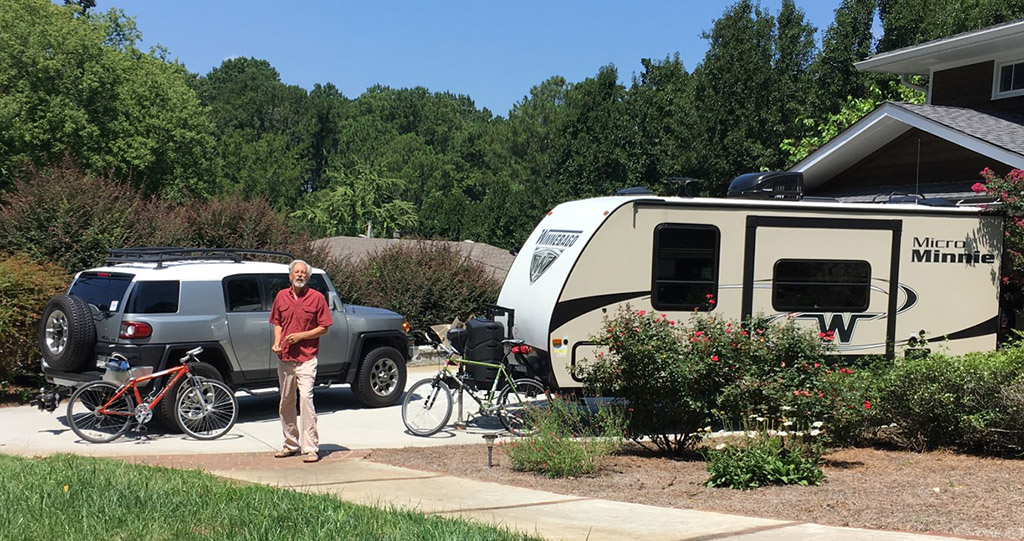
This 2018 entry is a meditation on reasons to explore the world by bike, as we transition from European Bicycle Adventure Club travel on “2 wheels” to an exploration of the vast natural wonders of North America on “12 wheels.”  A 4-wheel-drive SUV with a double-axle RV and 2 bikes. (4+4+2+2=12)

RV_2184

The 12 Wheel Configuration

Essential Question in a Time of Transition

In the PBS programs by Rick Steves, the opening bumper says that travel, like Public Television, enables us to to develop a better understanding of our world.  And, at its best, travel changes us for the better (experience great art, music, history, food, and people).  (PBS: secular sermons with aesthetic appeal.)

Rick’s site:

Travel is freedom… one of the last great sources of legal adventure. Travel is intensified living, with maximum thrills per minute. It’s recess, and we need it.

Compound Travel – Purposes and Modes

Part of bicycle travel is about the bike – about riding, self-propelled through the countryside, and feeling the wind in one’s hair.  Another aspect of being on 2 wheels is pauses along the way to experience a museum, a cemetery, or a magnificent cathedral. Or, merely sit quietly by the side of a river, contemplating the flow of the universe.

Some of us refer to such contemplation as more than mere recess: it is a retreat – a hiatus from the chaos of the immediate now.  (At a minimum, a treasured respite from the incessant buzzing of social media.)

Last year, based on an offering by our favorite yoga teacher, we tried a new first: a yoga retreat.  With travel: a retreat on the Pacific coast of Panama.

This year, we would try another yoga retreat in a new location: Iceland.

B_Lag_v1

Blue Lagoon – classic part of Icelandic tour

In an effort to combine several opportunities into one massive fun vacation, we decided to bound our Yoga Retreat in Iceland with RV travel.  Partly, this was the result of discovering that relatively inexpensive travel to Iceland on WOW Airlines originated at the BWI airport. Baltimore being the closest city to Atlanta to catch a WOW flight.  


A brilliant plan, on a conceptual level.  However, this Yoga Retreat (my naive hopes reconfigured) was, in its full-bodied reality, a Yoga Adventure!  And, without much effort, RV travel can also become an Adventure.

In retrospect, why both Adventures?  Together? Without a restful break in between?

As the context of the above questions implies, I’m now home, but sick – both physically and psychologically from too much chaos.  Some folks want “maximum thrills per minute,” but some of us old folks want rest and recuperation from too many thrills imposed by our normal life.  We travel to see new sights, at a sensible pace. We travel for a chance to meet new people. Nice people.  Blue Bubble people. Courteous people. And, we want an escape route if the ostensibly nice people turn out to talk too much or express ignorant prejudices.  (When one of our friends, a well read conservative whose service in the Air Force did not seem to completely warp his political sensibilities, started to refer to Alexandria Ocasio-Cortez as Bolshoi Barbie, i realized that it was time to get up to refill my wine glass – and, breathe deeply.)

In fact, we older folks view “recess” as a time for gentle reflection – not a time to run full speed in an unfamiliar environment.

Control: the hidden variable

Within the world of travel, many tour companies provide a pre-packaged experience.  (e.g. a Yoga Adventure)  Naturally, the personal reactions of each traveler will be unique – but, the overall schedule is in the hands of The Tour.
(remember: ”
If it’s Tuesday, this must be Brussels…”?)

Usually, one’s fellow travelers are compatible people who have purchased the same experience.  They may be nice people. They may enhance experiences by sharing their perspectives on the Grand Masters…  But, as we all know, it only takes one truly rude and selfish person to completely sabotage synergistic enthusiasm.

On the other end of the travel spectrum is the solo voyage.  (“I did it my way…”)

Adventure vs Retreat

OMG_v2

The real Blue Lagoon Adventure

Given the preference for rest and reflection by older, gentler people, a delightful “adventure” could be quite tame.  It could include a visit to a museum. Not necessarily a high-end museum. (think mad dash through The Louvre: how many masterpieces / hour?)

For example, I had a lovely solo visit to The Mariners’ Museum in Newport News, VA.  Quite small (compared to really well known museums).  And, delightfully uncrowded.

Pacing by a solo visitor can reflect personal interests and evoked curiosity.  The process of thoughtful interaction with displays of art, technology and the instruments of naval warfare, had been quite intimate.  Upon my return from my gentle adventure, I enjoyed sharing the experience with my wife.

And, surprising perspectives can appear.  At its best, for me, travel is educational.  It provides new information. It redefines existing knowledge with extensions to what is already know.  It enhances understanding. And, in an age of truthiness, it can be a corrective for inaccurate facts and divisive misunderstandings.

Balance: Planning and Flexibility

Travel by a couple (or, solo travel) requires planning.  That exercise is often a catalyst for inquiry into the essential question: Why Travel.  

What conceptual goals (intensified living? universal truths revealed by a different cultures? escape from the tedium of work?) are the key objectives?

What do you want to do?  (“Only in Iceland can you drink white wine while getting a silica facial while relaxing in a geothermal hot spring…”)  (Best: parasailing; biking; surfing; hiking…)

What do you want to see?  (“We’ll get to see a real geyser!  We’ll see the aurora borealis. A five-gaited horse. Windswept beaches…”)  

Joy_2089

Joy and new friend

Who do you want to see?  (Auntie Abigail. Grandpa Louis, before he goes into hospice.  The Rolling Stones, on their last-last-fucking-last tour…)

If the itinerary is in the hands of a tour company, you can avoid planning challenges (priority compromises of a couple…).  But, you lose almost all flexibility. (“Let’s spend another day here to visit the museum…”  No chance!)

However, if the itinerary is in your own hands, the planning challenges are unavoidable.  All the Who What When Where How question become relentless. And, contingency plans (“Yipes, the weather has gotten even worse!”) require more exploration of options.  But, you have total flexibility. (“Let’s spend another week in this charming Airbnb”) Of course, the unintended consequences of changes to schedules may have wide ranging impacts.

Odd combination: RV + Travel Yogi + RV  

(1 Week Each!)

Planning – the possibilities are endless

a set of checkboxes

After our discovery that relatively inexpensive travel to Iceland on WOW Airlines originated in BWI airport near DC, we formulated the Great Combined Travel Adventure.

Ah Ha, we said.  We can visit friends as we head north through the mountains with our RV, park the RV in the driveway of friends in Virginia, spend time with relatives in DC, and take Amtrak to BWI.  On our return, we can wend our way home along the coast after a restorative week of yoga.

{Note: this is essentially a Joy-esque plan.  My general rule-of-thumb is that it is better to do three things well than to do six things badly.  But, Joy’s observation is that if you attempt to do seven things, you will probably accomplish four or five of them.  The fact that two or three things do not happen will probably piss off only a few people…}  

In a sense, the plan was rational.  We could continue to deepen our RV skills without adding the bicycle component.  We would have a chance to visit several wonderful people. We would experience diverse aspect of RV travel in the South (State Parks, KOA, Bubba’s RV Pit Stop… + mountains and seashore…)  We could visit museums in DC, and more!  At least 7 more exciting things!  Including taking the RV on an ocean-going ferry.


Post-Mortem: the chaos was relentless

First, the good news:

  • We did deepen our RV skills.  Better at: hitch up & go; stop & unhitch…  techniques for a one-night stop vs. stay awhile…  (Better at sewer connections (dumping can be a continuous process – who knew?)  (who would want to know?)
  • We visited friends and relatives.  What is it like to restart one’s life in a new city without the baggage of a dysfunctional marriage?  What is the reality of a high-end DC couple with exciting careers and high ambition? What is the reality of a traditional Virginia deep-state couple with one career and retirement in sight?  Who would go on a Yoga Adventure? And why?
  • New culture: Iceland, once a colony of Denmark is not exactly European, but certainly not part of the new world, despite the intersection (separation) of the continental plates.
  • Great food.  For those of us who love lamb and just-off-the-boat fish, Iceland is the promised land.
  • Good weather – until it was gone.  Easy RV travel: little rain for first week. (whew!)  Only a few drops of rain in Iceland until the last day of hiking.  Then, quite cold and wet.Joy in the rain
  • At the start of the last leg of the trip, scattered showers, that could be mostly avoided, in DC and Virginia.  Then the deluge. Flooded roads. And, to confirm my worst fears that RV stands for Redneck Vacation, I spoke to a cigarette smoking KOA worker as he paused in a mud puddle while riding his equipment-filled golf cart.  “How are you, today?” I asked. “I’d be OK,” he answered, “if I could just figure out where to put all this water at.”
  • Listening to a free meditation: Deepak & Oprah discuss desire as OK (if it’s in pursuit of one’s true destiny).
  • Listening to an audio book: The Swerve: How the World Became Modern – (Stephen Greenblatt) discusses Epicureanism, as defined by Lucretius: OK++ (if it’s not just hedonism).
  • Note: both audio sources give no credit (Greenblatt) or little credit (Deepak & Oprah) to organized religion.  In fact, secular humanism (Greenblatt) and ephemeral spiritual effulgences (Deepak & Oprah) seem to be the catalysts for the effective progress of civilization.

Bad news:

  • Navigation in the world of bicycle travel is challenging.  [link!] Navigation for RV travel has its own moments of difficulty.  
    Driving into any gas station in a car makes perfect sense: gas stations were designed for cars.  Duh! However, the original design of the average gas station did not include a vehicle towing a 19 foot trailer.  A trailer much taller than the car. (Full height of our “Winnebago Micro Minnie” – 9’ 7”)  Careful inspection of the scope of gas station areas has prevented a disaster, so far.
    As a general rule, phone-based GPS systems work well.  However, not every area in rural America has good (read: AT&T) mobile phone coverage.  The iPhone’s navigation does poorly when out of contact with the Mother Ship. And, in rural South Carolina, road improvements can result in just enough displacement to imply that one is off the correct road.  
    “Proceed to the Route!”  Making a required (or, apparently required) U-turn with an RV is not easy.  Not easy, despite the fact that some 4-lane highways in South Carolina have occasional legal U-turn openings.  Who knew? (Allowing a U-turn on a 4-lane highway seems a bit like having an emergency exit in an elevator, but – oh well, different cultures…)
  • Bad weather.  Rain is essential for the growth of trees and flowers.  And, crops. So it is natural to celebrate a bit of wet weather.  If a seasoned traveler has a raincoat and/or an umbrella, occasional rain is not a serious inconvenience.  The British put this well: “There is no inclement weather, merely inappropriate clothing.”
    However, Iceland had 31 days of rain in May.  Too much.
    iPhone screenshot of wet weather forcast
  • Coastal North Carolina (Outer Banks) greeted us with flooded roads.  Fun to pilot an RV through an ad hoc swamp?  No.
  • WOW Airlines.  I suspect that the name comes from: “Wow! I can’t believe that they screwed this up, too!”   After getting bumped out of our exit row on the flight to Iceland (“Oops, sorry about that,” said the flight attendant), we were quick to notice (before boarding the flight) that the same thing happened on the way home.  “Oops, sorry about that,” said the person at the customer service desk in Reykjavik airport.  “Maybe the flight crew can fix this…” Nope. So much for paying extra for a bit of legroom…
  • Amtrak.  Good safety practices mean that it is a good idea to wait for all exiting passengers to leave the train completely before pulling away from the station.  Amtrak probably does that most of the time. But, at the BWI airport stop, several of us were terrified to discover that we needed to pry the doors back open – only to step from a moving train onto a stationary platform.    A young girl screamed in horror as she realized that she might be separated from her mother until the train reached the next stop…
    How to complain?  One answer is: “don’t bother with a complaint.”  No broken bones, no lost children, no serious difficulty.  Just keep moving…
    But, if serious disasters are to be avoided, civic responsibility requires bringing near-disasters to the attention of people who can improve safety procedures.  So, a chat with the person at the ticket counter in the station. “On Monday, call this number, and ask to speak to Customer Relations,” she said. Apparently customer relations is not a needed function on weekends.  But, we were off to Iceland in a few hours, and an international call to a 1-800 number (with a voice menu system and musical hold delays) seemed a task that was best done in writing when back in the USA.
    Eventually, a response…
  • Travel can be exciting and invigorating.  It can also be too exciting. Some of us contemplative types call that stress.  And, the more complex the travel becomes, the more likely excessive invigoration will sour into rancid chaos.  Exhaustion and illness often follow.


But, Bad News is merely a footnote if one returns with good memories, amusing stories, and an appreciation for new ideas and perspectives.


New Thoughts on the Nature of Travel

At the start of this blog entry, I mentioned the purposes of travel: “to develop a better understanding of our world” and “to experience great art, music, history, food, and people”.    

Of course, a “better understanding of our world” often includes a deeper understanding of ourselves.  We appear in a new context; we imagine who we might have been in an earlier age; we contemplate the ebb and flow of civilizations.


Retreat (as technique for renewal):


Retreat_v1

Getty Images/ Hans Huber/ Red Chopsticks Images
https://www.shape.com/fitness/trends/runner-first-weekend-yoga-retreat

In its most general sense, a “retreat” means a quiet or secluded place in which one can rest and relax.  In a religious sense, a “retreat” means a period of seclusion for the purposes of prayer and meditation.  

Although yoga, in its Western spandex-clad aerobic incarnation is no longer a religion per se, I have sometimes referred to inspired yoga teachers as acolytes of the Church of The Sticky Mat.

Indeed, one of the reasons for our 2017 Yoga Retreat to Panama was the spiritual nature of the yoga instructor, the trip organizer.  Her classes are a reminder that, at its best, the world of the body, the mind and the spirit all harmonize with the same universal laws.

And, she was the instructor / leader of our Yoga Adventure in Iceland.


Adventure (as a way to run with scissors):


Adventure_v1

Style Lemon

As a noun, “adventure” means daring and exciting activity calling for enterprise and enthusiasm.  But its first meaning also has implications of engaging in hazardous activity, especially the exploration of unknown territory.  Even to put one’s life at risk.

Iceland is not an unknown world.  However, incessant stimulation (yoga classes, frenetic bus travel, incessant conversations, long kikes in the overgrown lava fields…) can easily transmute a retreat into an all-too-exciting adventure.


Conclusion

The entries in this blog since its start (2012) have been about European bike travel.  That focus has enabled not only comments on bike travel itself, but also reflections on the layers of culture that motivate much European tourism.

Farmer_v1

Irish farmer – 2004  (First European bike trip)

Travels in Europe, often informed by prior understandings of history, augmented by thoughtful comments from guides, and enriched by conversations along the way, illuminate the trajectories of some of mankind’s extraordinary developments.

Beyond the hypothesis of Guns, Germs and Steel by Jared Diamond, there is a complex and subtle flow of ideas of progress, examples of regression, monumental accomplishments, horrific periods of repression…  A panoply of experiences: great art, music, history, food, and people across centuries.

In European Bicycle Adventure Club travel there is no need for audio books; no time when stuffing MP3-connected earplugs into one’s ears makes sense.  

But, in RV travel, when one is on the move, it is possible to connect an iPod or iPhone to the speaker system of the tow vehicle.  Then, a travelling couple can listen to and comment on an audio book that illuminates aspects of European progress or a web-hosted mediation on the best way realize one’s dreams.

Audio

As we traveled between Atlanta and Newport News in the weeks before and after the Iceland Adventure, we listened to two sources of enlightenment: (as mentioned in “Good News”)

Oprah and Deepak’s meditation on “Desire” as a proper goal for focusing your life:

The Origins of the 21-Day Meditation Experience

“Meditation is a simple practice that brings profound results. This truth – known personally to both Oprah Winfrey and Deepak Chopra – is the driving force that inspired two of the most influential spiritual leaders of our time to come together to create their ground-breaking 21-Day Meditation Experience Series.”  [link]

The audiobook version of The Swerve: How the World Became Modern by Stephen Greenblatt is “both an innovative work of history and a thrilling story of discovery, in which one manuscript, plucked from a thousand years of neglect, changed the course of human thought and made possible the world as we know it.”  [Amazon link]

Suddenly, despite our physical location in the mud puddles of coastal North Carolina, we were exploring other worlds.  

In the case of Oprah and Deepak, we transitioned into the world’s wisdom traditions with a pervasive assumption about the inherent goodness of each person – and the beneficent splendor of our desires.  In the case of Stephen Greenblatt, we had a more nuanced view of human nature – and persuasive arguments chronicling ideas that influence the course of history. Views of the universe defined without support from a specific religion.

Indeed, Greenblatt’s central argument explaining “The Nature of Things (De Reum Natura)”, a poem by Lucretius, is that the next world, the world of the Roman Gods (or, by implication), the God of the Judeo-Christian tradition, does not exist.  We are merely atoms. Interesting collections of matter, combined at a point in time to form beings that eat, experience attraction, and procreate. Therefore, our highest good is pleasure.  

The authorities of the ecclesiastical world have opposed this heresy since Lucretius created his masterpiece in the time before Christ.  In the centuries since its rediscovery by Poggio at the start of the Renaissance, paroxysms of book burning have included this volume.

As the The Swerve progressed in its wide-ranging observations on the impact of new ideas, it jogged a vague memory of Girolamo Savonarola’s fanatical excesses to suppress hedonistic behavior.  I had forgotten (if I ever really knew) that his religious fanaticism occurred in Florence, the epicenter of the Renaissance.  How, I asked, could the best educated population of Europe – the supporters of scientific exploration and artistic excellence – endorse a rabid priest who advocated the destruction of the accomplishments of a civilized world?

And, how could those same “civilized” people – four years later – burn Savonarola at the stake, in an apparent effort to reestablish a city with a lower level of religiosity?  (A return to ”the pursuit of happiness” – so to speak.)

Perhaps, Savonarola – sensing pervasive excesses of pleasure seeking, observing the encirclement of Florence by infidel forces, appealing to memories of a more prosperous time – hit upon the perfect slogan to rally the pathologically religious: “Make Florence Great Again.”

Savonarola_v1


Clearly, the nuanced layers of Europe’s civilizations – whether experienced directly on 2 wheels or experienced vicariously through brilliant observations – have relevance to a deeper understanding of our world and of ourselves.


Soon, more travels on 12 wheels.  And, eventually, back to Europe for more exploration and reflection.


Into Belgium: the Journey Ends

14 Thursday Dec 2017

Posted by 2wheels2travel in Uncategorized

≈ 1 Comment

The previous post concluded with comments about the last rider along the canal – a European cyclist who would want fresh bread at the start of each day.

We all want a long ride – good food every day, wonderful friends…  But as we left Tournai, it was clear that our two-week ride was nearing its final stage.

As we continued into Belgium, we were leaving the land of “wine culture.” We had entered the region of “beer culture.”  What would be a more natural celebration than a beer tasting on our barge one evening?  And, which crew member would be the natural presenter of an historical perspective of traditions of beer which go back to fermented fruit juice?  (Yes, there is cherry beer!)  The choice was the engineer, Michael, who was in charge of all things mechanical, and who shared pilot duties with the captain.  Like everyone on board, his education was broad and deep.  And, his respect for the traditions of food and drink was clear.

Samples of
Samples of
Belgian Beer
Belgian Beer

Beer 0

Beer Tasting and Laughter

If you ride 50 kilometers each day, you need good food to start the journey.  And, at the end of the day, a glass of wine or beer can be helpful to ease the pain of a few sore muscles…

At our stop in Ghent we found not only local beers, but a perspective on Europe’s ongoing efforts to merge the old and the modern.  Part of this challenge is transportation: pedestrians and bikes with cars and trams.  Another part of the challenge is in the area of architecture.  Integration of Renaissance / Gothic with functional modern.

Traditional
Traditional
New
New

comined arch

A Modern City

Of course no visit to a European city is complete without visits to the twin monuments of historic urban life: a cathedral (architecture of worship) and military technology (architecture of warfare).

Ghent - Cathedral
Ghent – Cathedral
of St. Bavon
of St. Bavon

Red Gun

Christan explains the Red Gun (Dulle Griet)

Red Gun from 15th Century


Into Bruges / Brugge 

Our last ride was from Ghent to Bruges.  From a bustling modern city with a storied past into a meticulously preserved city that was once “the Venice of the North.”

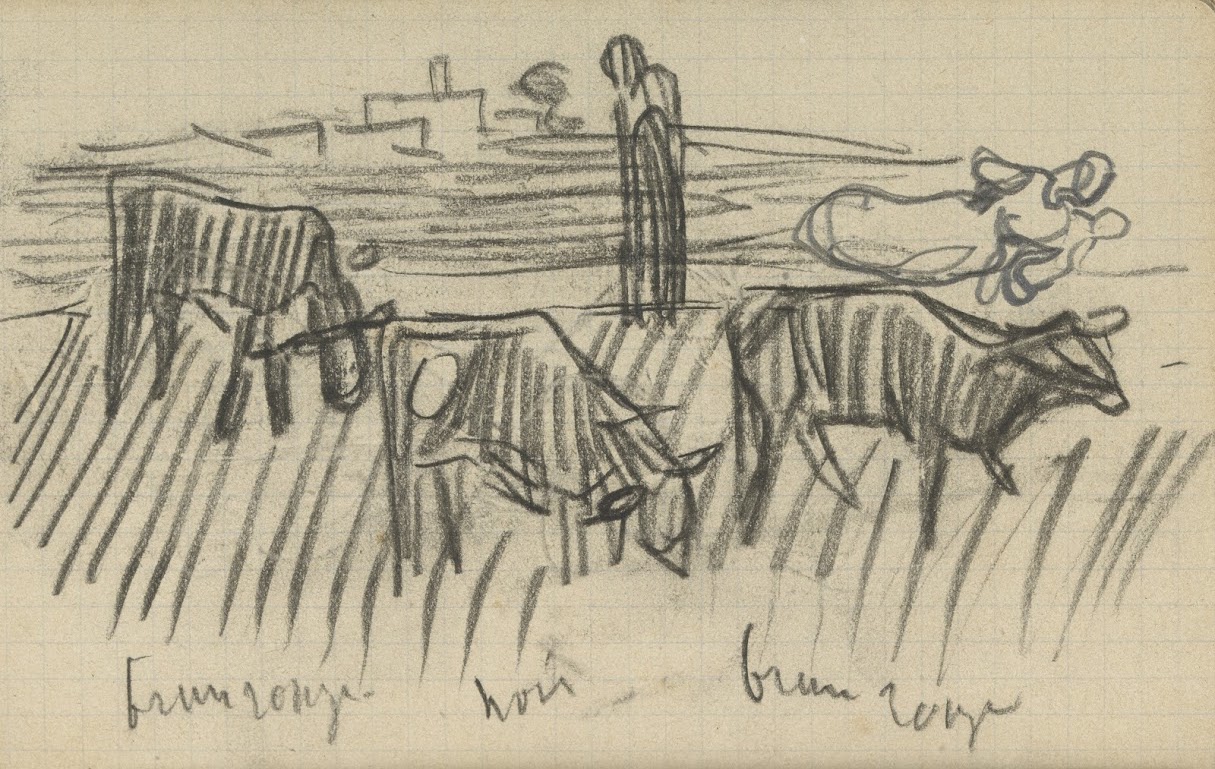
Our ride was unusually swift and gentle – a quick stop at a rural cafe for coffee and a mid-morning croissant.  We cycled past many fields of placid cows that seemed to be posing for pictures of bucolic boredom.  Even Vincent Van Gogh would have had difficulty finding aesthetic substance in such a bland swath of farmland.

vangoghmuseum-d0414-063V1962-1920

Van Gogh sketch

Our ride was mercifully shortened by a tailwind. Without the hindrance of traffic or pedestrian congestion, we maintained a record pace.  I finally used the highest gear on my bike.  (It should be noted that on an earlier day, one of the riders – sprinting to the front of the peloton – announced that her progress had been slowed by “running out of gears.”  Such is the variance of skill and speed in a 24-person tour.)

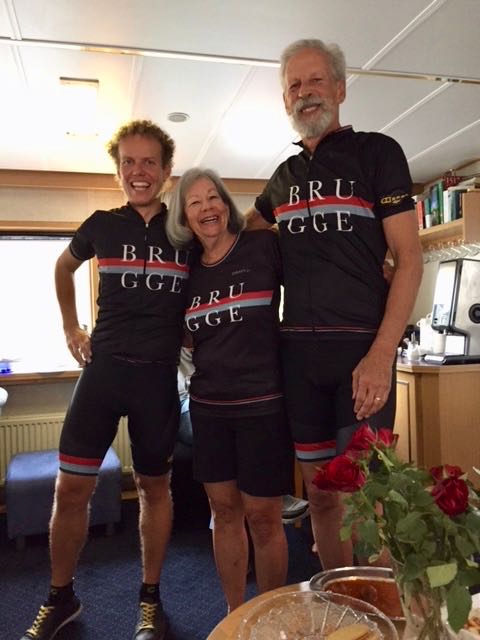
Before our lunch stop, we reached Bruges – and, our arrival was a form of celebration: a two-wheeled, two-week journey completed.  A short stop for a picture of our 3 leaders: Christan, one bike leader; Birgit, our BAC leader; Ilaria, our other bike leader.

Christan + 2

Christan, Birgit, and Ilaria

We had time to hear a history of Bruges from Christan – and, tour a few shops.  Yes, a once vibrant “Venice of the North,” has become a well-appointed nouveau shopping city for tourists.  It survived a period of suspended animation from about 1500, when the river to the sea silted in, to its post-World War II status as a well-preserved artifact of early Renaissance Europe.

Bruges – Golden Age: (12th to 15th centuries):  As commerce increased from the river, and as canals were built, a city inside fortified walls was constructed. The street plan of the inner city remains the same to this day.

The Bourse opened in 1309 (most likely the first stock exchange in the world) and developed into the most sophisticated money market of the Low Countries in the 14th century.

In the last half of the 19th century, Bruges became one of the world’s first tourist destinations attracting wealthy British and French tourists. The historic city center is now a prominent World Heritage Site of UNESCO.

After our personal tour and shopping, we returned to the Zwaantje for our last supper; A special meal savored  with great camaraderie and several toasts to a group that had developed the rapport of a close-knit family.

IMG_1655

Dessert

Bruge Bros

Bruges Brothers (Christan & Arthur) with Suzie

IMG_1698

Group photo – (refer to Official Trip Report below)


Beyond the Tour

One question in any travel adventure is how much time to spend in each location.  On a bicycle tour, much of that question is answered: one day per town.  And, really, part of one day.  (If it’s a rest day, maybe time for some exploration…)

Joy and I decided that we might never return to Bruges.  Given its significance and charm, extra days seemed sensible. How could we leave this enchanting city without sampling its well-deserved culinary reputation: moules et frites and chocolate?

mussels

moules et frites

Our visit to the Markt (“Market Square”) enabled us to visit a chocolate fête in the main exhibit hall.  We encountered dozens of unique presentations of the magical dark concoction.  More are produced in Belgium than anywhere else in Europe.  Champagne with chocolate (less sweet than you might think), hazelnuts with chocolate (better than you would suspect), carefully hand-crafted chocolate pieces (more expensive than what you might spend), anatomically correct artifacts of chocolate (more erotic than what you would find in a U.S. candy store)…

And, of course, informative conversations with the vendors.  A serious discussion of chocolate in Belgium is much like a serious discussion of wine in France: the word, terroir, is always mentioned.  People wax poetic when describing the DNA of a specific plant, the chemical attributes of the soil, the unique advantages of a specific climate, the loving care used in the harvest…  “This is why our product is so unique.  You must taste a little more…”

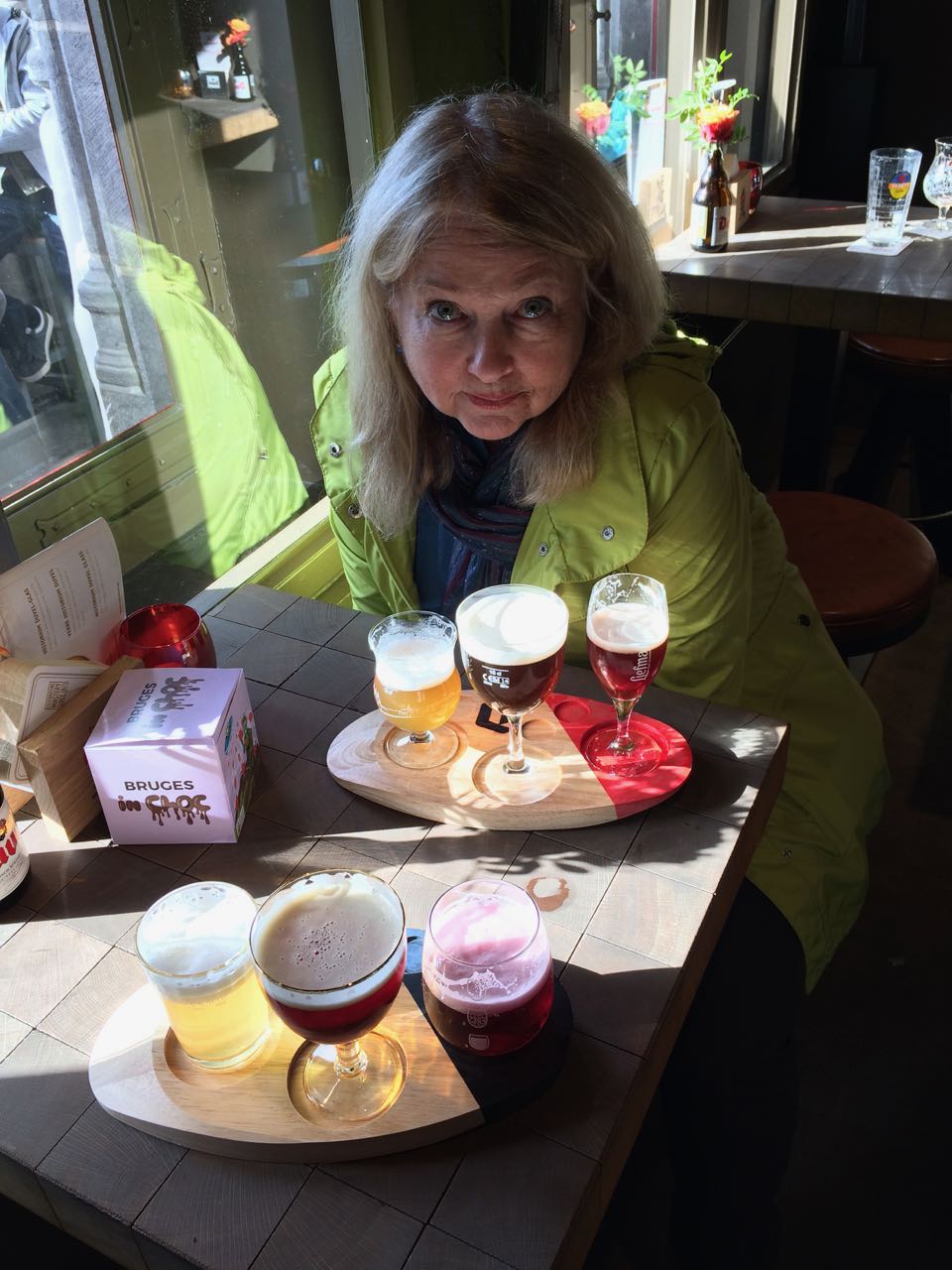
A little more tasting of everything, including beer.

six beers

a flight of 6 beers

Success as a financial center often results in success as a center for artistic excellence.  That was true at the height of Bruges’s success.  It is still true today.  Bruges is one of the few cities in northern Europe that has a statue by Michelangelo:

Bruge_Jesus_0018

Madonna of Bruges

Head of Mary
Head of Mary
Head of Jesus
Head of Jesus

Madonna of Bruges

One variant of the story of the sculpture’s arrival in Bruges is that the Pope, for whom the statue was created, found it  too evocative of human physicality – too ambiguous in its spiritual essence.  Not appropriate for display within the Vatican.

Like many creative geniuses, Michelangelo may have tried to reconcile the theology of his day with an innate sense of how human beings relate to metaphysical reality. The Madonna appears lost in deep contemplation of the fate of her unique child.  A young Jesus seems, although fully human, engaged by his burgeoning awareness of a special role.

An extraordinary artistic blessing for Bruges.

In the 20th Century, artists have turned from a celebration of the nature of the divine to a depiction of the horror of man’s inhumanity to man (perhaps with a scriptural assist).

In central Bruges is a set of evocative modern sculptures: The Four Horsemen of the Apocalypse, created by Rik Poot.

IMG_1696

Sculpture attribution

Apocalypse 1
Apocalypse 1
Apocalypse 2
Apocalypse 2

Apocalypse 3
Apocalypse 3
Apocalypse 4
Apocalypse 4


A Last Ride to Connect the Dots

While in Bruges, we decided to do one last ride.  There is something to be said for “Bike Tours” of any European city.  There is always a guide with extraordinary knowledge of the city and extensive insight into its culture.  There are invariably shortcuts that lead to hidden treasures.  And, without fail, there is the stop for refreshment.

Just like our tour in Amsterdam, the two-wheeled extra ride in Bruges was wonderful: yet another perspective on its pre-Renaissance architecture and 800 year-old streets.  More visions of its special artistic shops…

IMG_1680

A lovely shop

At our beverage stop, where we discussed what we had seen so far and what would appear soon, the two Australians ordered beer.  Joy and I had a cappuccino – as did the young couple from Amsterdam.  It was at that point that I noticed that the young woman was pregnant.  “Will this be your first child,” I asked?  “Yes,” she replied, “in about three weeks our first child will be born.”

“Ah,” I thought.  A true Amsterdam woman – riding a bike on cobblestones when 8+ months pregnant.

If you visit Bruges, try: Quasimundo Bike Tours

“Brugge by bike has been our classic tour for many years & is a must-do for anyone visiting Brugge.”

Atlanta Reflections and efforts to BLOG

Based on the delays in creating Blog entries, it is clear that – for me – writing about travel is not a real-time effort.  As I age, travel is more interesting, but takes more time in planning and in reflection.

Each phase has its rewards:

  • Planning exposes the myriad possibilities of what exists beyond one’s home;
  • An actual tour produces camaraderie among fellow riders
    • and, unexpected encounters within each journey;
  • Reflection discloses themes in life – both individual and collective.

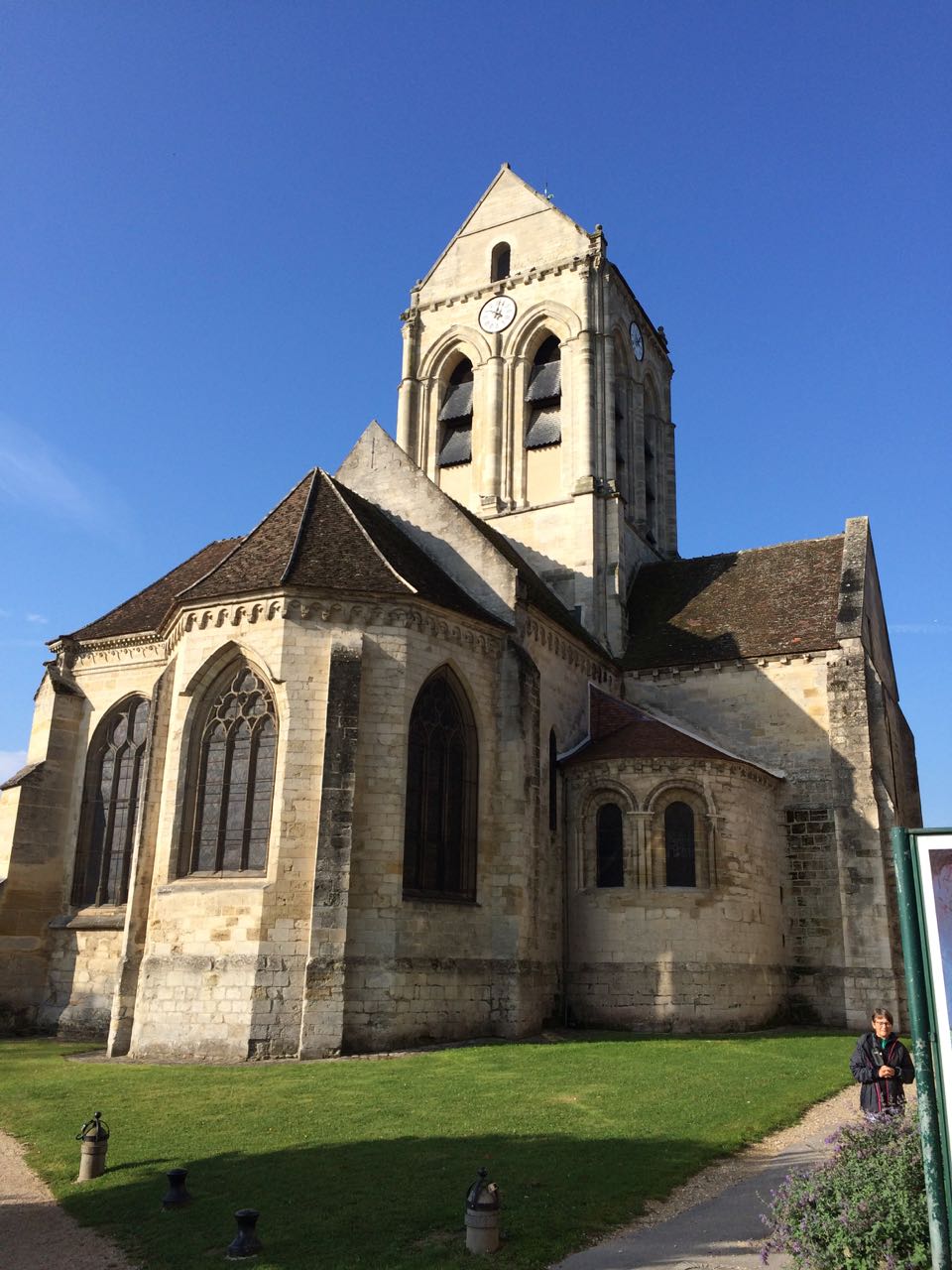
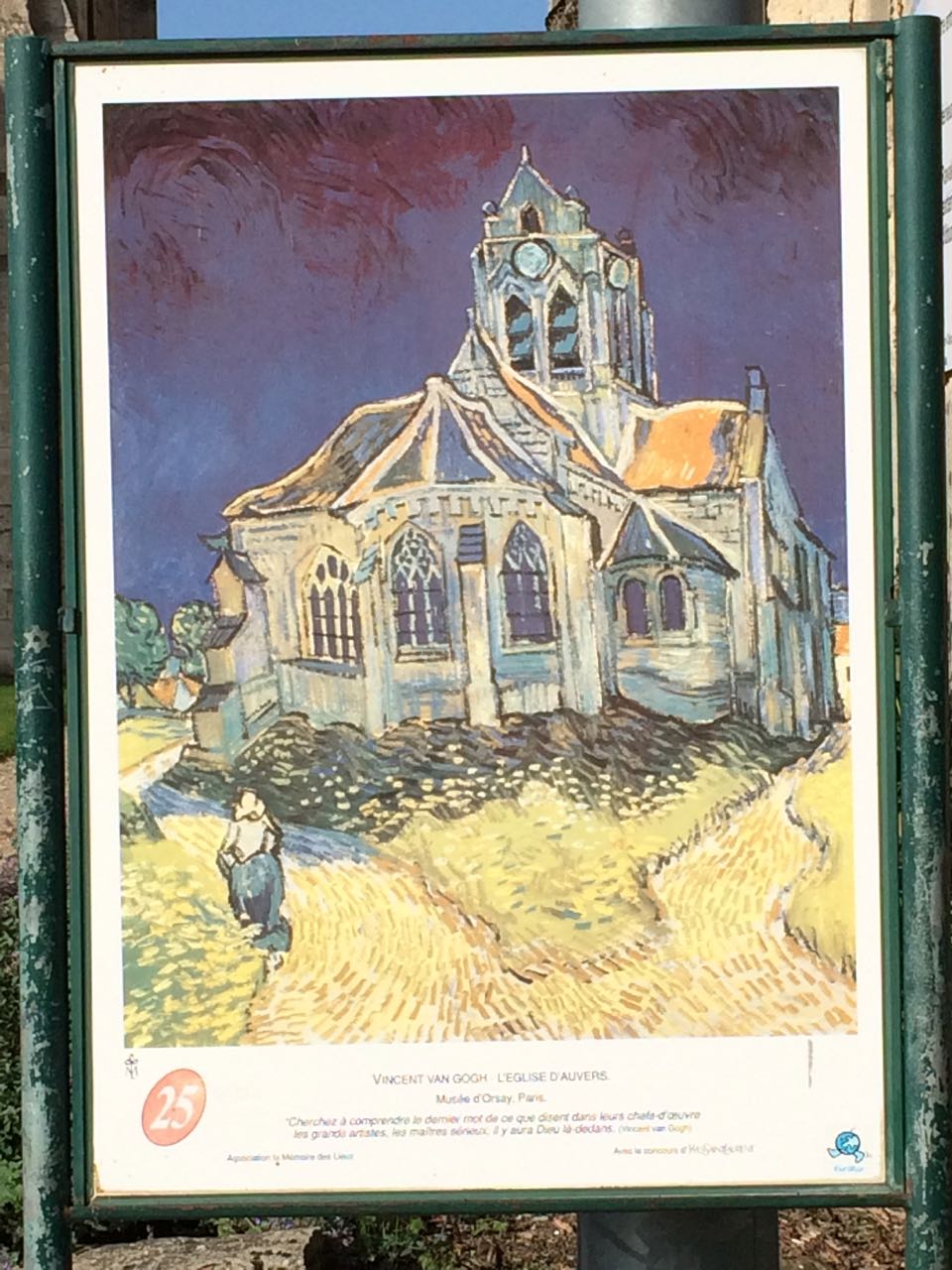
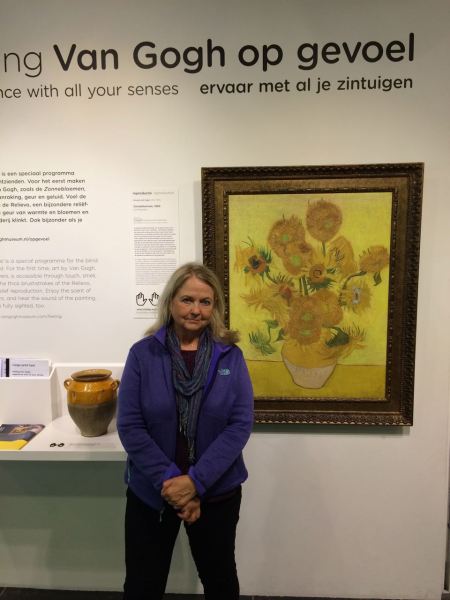
For this journey, one of the poignant themes was Van Gogh.  From an inspirational visit to the Van Gogh Museum in Amsterdam, to his gravesite in ⁨Auvers-sur-Oise⁩, ⁨to the many vistas along the bike paths that evoked his vision of a rural life of dignified struggle, his unique embellishments of color and form seemed to follow us and imbue every new encounter with an impressionistic light.

It was an astonishing synchronicity to return to Atlanta and see the release of a new film about his life: “Loving Vincent.”

New York Times: Review: ‘Loving Vincent’ Paints van Gogh in His Own Images

By A.O. Scott Sept. 21, 2017“A long and arduous labor of love by Dorota Kobiela and Hugh Welchman, the film turns van Gogh’s work into an unusual kind of biopic. Using tens of thousands of oil paintings commissioned from scores of artists, the filmmakers transform famous works of modern art into a hypnotic and beguiling cartoon. The people van Gogh rendered on canvas — the provincial French functionaries, doctors, barmaids and farmers immortalized on museum walls — are brought to uncanny life, with the voices of professional actors, some of them well known.”

NYT_lovingvincent

From NYT review

My sense is that Van Gogh’s journey was one of self-discovery – a struggle, heroic in astonishing ways, to use a two-dimensional canvas to expose the vast and transitory reality that is the vibrating essence of life itself.  His crossing into a world of imagination is able inform our explorations – journeys that have lasted much longer than his own.

References / Credits

Bicycle Adventure Club: https://www.bicycleadventureclub.org/html/

“The Bicycle Adventure Club (BAC) is a non-profit, bicycle touring club for serious cyclists run by its 1,500 volunteer members. Members create for each other a variety of bicycle tours, both domestic and foreign. Our heritage goes back over 40 years to the International Bicycle Touring Society; the club as it currently exists began operating rides in 1983. We have a large number of members who have been with the club for many years. We enjoy the camaraderie of exploring the world with our cycling friends on tours developed by club members for other members.”

Official report of the Paris to Bruges trip: BAC_write_up.

Tripsite:  https://www.tripsite.com

“Tripsite is your comprehensive marketplace for cycling holidays in Europe, Asia & beyond, showcasing hundreds of tours for the discerning cyclist, including bike and boat tours, bike tours, and multi-adventure tours!

Offering a diverse portfolio, there are tours to fit any budget, from luxury to value and tours to suit any interest including history, culture, and gastronomy. Tailored made tours are possible as well!

Tripsite has been family owned and operated since 1999 and we are renowned for unsurpassed customer service and extensive knowledge of every tour we offer. Contact us! We will provide you with an adventure you will never forget. We promise!”

Specifics of booking the Zwaantje: https://boatbiketours.com/barge/zwaantje/

The “Zwaantje” (little Swan) is a fully converted passenger barge under Dutch flag and management with a length of 40 meters (131 ft.) that can accommodate 24 passengers. On lower deck the barge has 12 sleeping cabins: 10 twin cabins with two single beds each and two cabins with a double (French) bed. All cabins have a small en-suite bathroom with toilet, shower and wash basin, a fixed window (both double cabins have larger windows that also open) and individual air conditioning.

Good example of a bike-and-barge video:  https://vimeo.com/190065481

from Boat-Bike Tours.

Beyond Paris: A Journey Continues

02 Saturday Dec 2017

Posted by 2wheels2travel in Uncategorized

≈ Leave a comment

The previous post ended with comments about Barge Navigation.  It also included comments on the Compiègne Armistice Memorial.  Indeed, the itinerary of our Paris to Bruges journey could not avoid constant efforts to comprehend more fully both the Great War and the subsequent conflict.

Having started the trip to Europe with an arrival in Amsterdam – including a visit to the Anne Frank House – awareness of European battlefields was inescapable.  But, of course, there is more to travel than recognition of man’s inhumanity to man.

A constant theme of European travel is the relentless endeavor to construct Christian edifices.  They were central to the life of every city.  In ⁨Chiry-Ourscamp⁩ we found both the skeletons of abandoned houses of worship and also vibrant places of contemporary religious observance – evocative reminders of an age of faith.

A once lovely house
A once lovely house
of worship
of worship


Still an active
Still an active
worship space
worship space


In Saint-Christ-Briost⁩ we found an unexpected spot of interest: neither war nor worship, but a lovely fish hatchery with a restaurant.  Both local wines and local beers.  And, more navigation choices.

Fish 1
Fish 2

Most of us do not drink during a ride – but this ride was different.  Unlike the usual 50 kilometer rides, we encountered a truncated / extended option.  Remember the Barge Navigation post – canal traffic?  Canal delays had caused shorter barge travel and a nearer destination for the night.

So, the options were: eat, drink local beers and walk by serene lakes filled with fish; or, grab a quick bite of food and ride an extra loop into the hills.

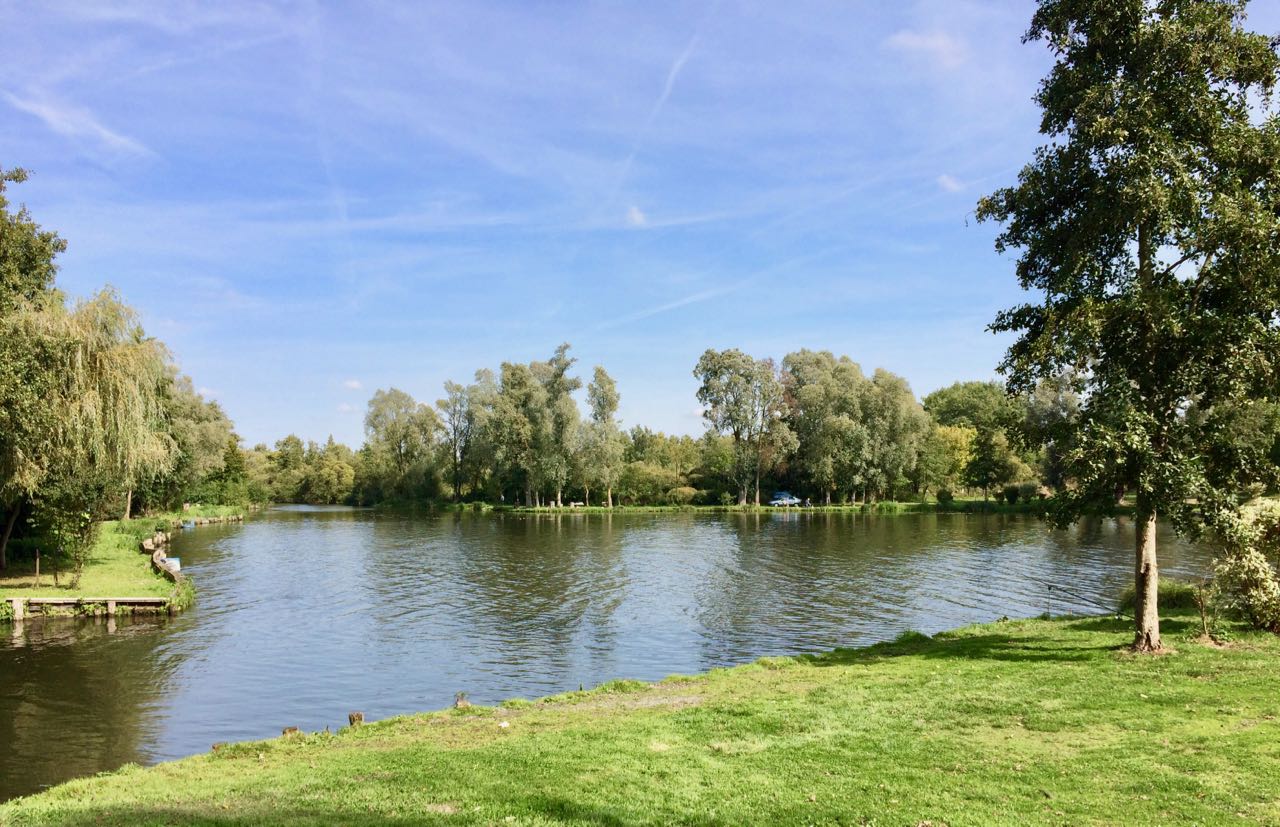
Below is an image of a serene lake.

Serene lake

Serene lake near hatchery

The following day was a Rest Day.  Why, a non-bike rider might ask, a Day of Rest?

Several reasons: a break for the crew of the barge; a time to let tired legs heal (even the Tour de France has rest days); more importantly – do laundry in a genuine Laundromat.

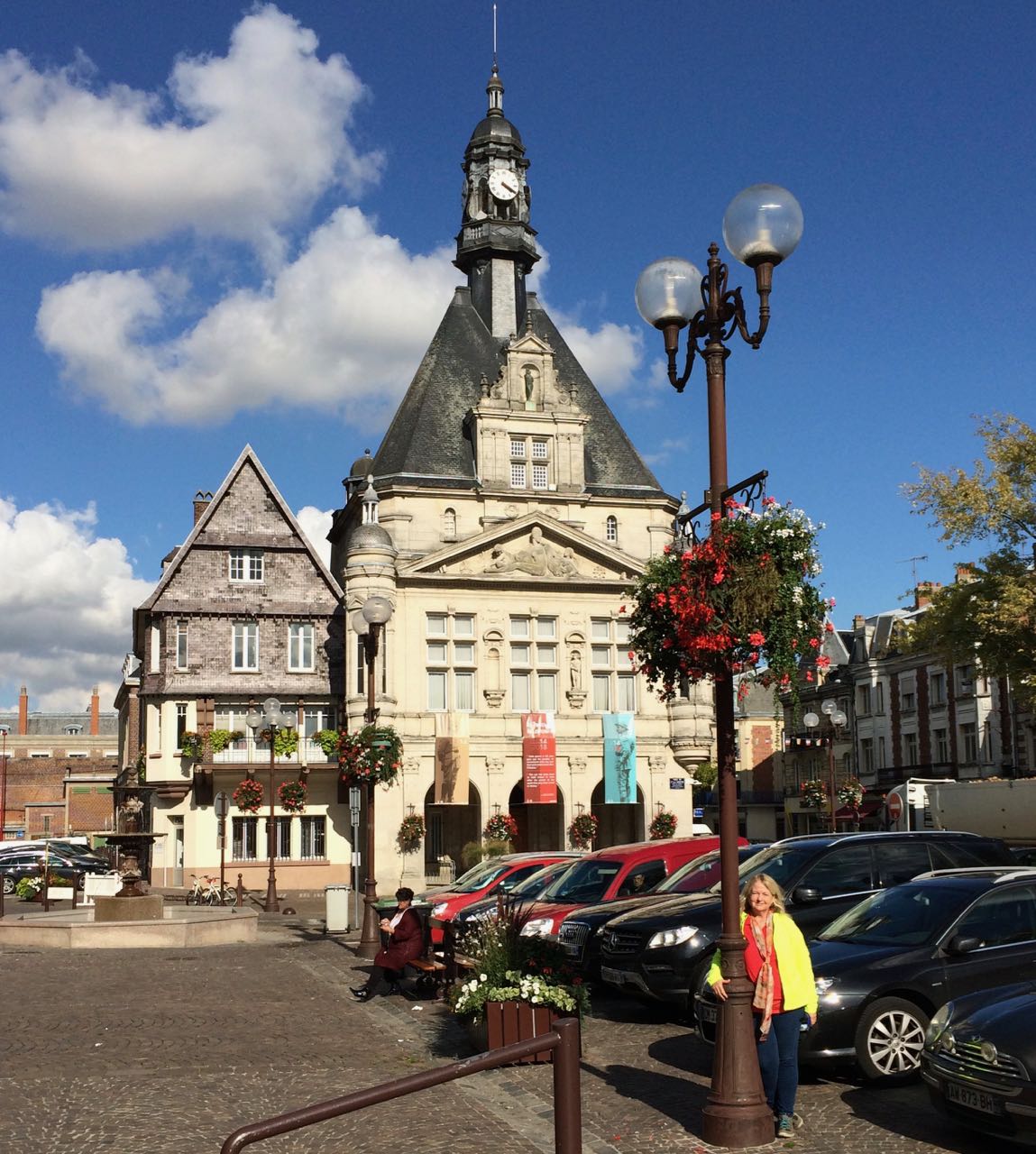
peronne

Center of Péronne

Our rest day town was Péronne: a collection of fine restaurants (remember: a day of rest / no cooking for the crew); and a stellar Laundromat.  Since Péronne is in the area of the Battles of the Somme, it has an extraordinary Museum of the Great War.

The museum employed an innovative format to display the uniforms and the kits (weapons and accessories) of the soldiers of the various armies (French, German, British, American, Australian…).  Instead of a vertical manikin dressed in a specific uniform, there were rectangular depressions in the floor containing uniforms with guns, writing implements, food containers, .…  It was as if someone had exhumed not bodies – but, the artifacts of soldiers.  A display that recalled shallow graves.  Looking down upon the empty uniforms of soldiers from 100 ears ago was as evocative as witnessing a field of crosses.

field_of_Crosses

Field of Crosses

  • Courtesy of The Atlantic (web article)


Cobblestones vs. Cobblestones

Although, as a general rule, bicycle travel is much more common and much safer in Europe than in the United States, all bike travel is a transportation retrofit.  Cities and road systems were designed to support pedestrians and horse-drawn conveyances.  Bike riders are not pedestrians.  Nor, are we able to compete in terms of speed and effectiveness with vehicles.  Much two-wheeled travel is recreational, not dependable transportation.

When automobiles became affordable for the masses, the bicycle became the odd-man-out in most urban environments.  Consequently, even in Europe, the pathways that bike riders travel are varied: from bike-only lanes commingled with motorized vehicles to separate allocated segments of a sidewalk…  and surfaces vary: from smooth paved roads to gravel textures on bike-only paths to dirt trails through a national forest…

On this trip we encountered everything.  Several riders noted that despite the relatively short daily distances (50 kilometers) and relatively flat terrain, there should have been a footnote expressing the need for technical skills.  That is, single-track mountain biking techniques and curb jumping prowess for urban transitions.

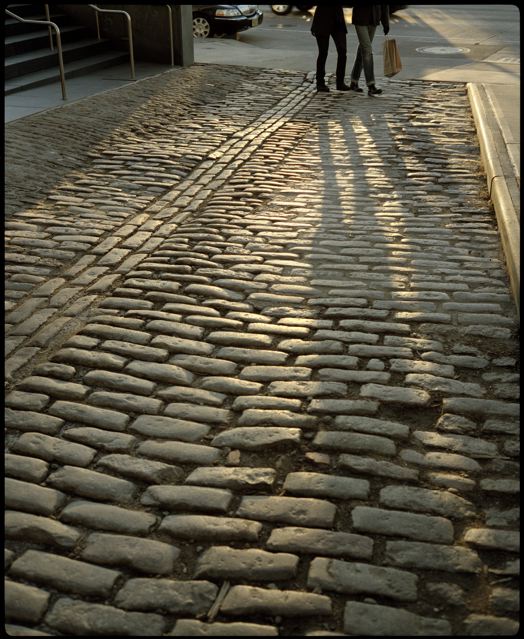
One form of surface is unique to Europe: cobblestones.  Riding on this unique surface is recognized as a separate and highly regarded ability.  We encountered the signature event that celebrates this quixotic endeavor: an 85 kilometer race on cobblestones.

The Paris–Roubaix is a one-day professional men’s bicycle road race in northern France, starting north of Paris and finishing in Roubaix, at the border with Belgium. It is one of cycling’s oldest races, and is one of the ‘Monuments’ or classics of the European calendar, and contributes points towards the UCI World Ranking.

https://en.wikipedia.org/wiki/Paris–Roubaix

Cobblestone
Cobblestone
Ride
Ride


Even without bouncing on cobblestones, bike-and-barge life can be difficult.  The illness that made its way through the group continued.  Some of the ill folks recovered and went back on the road.  Some folks who appeared invulnerable succumbed to a day or two in sickbay.

The advantages of “sickbay” were conversations among the community of invalids – and, chances to read and write in peace.

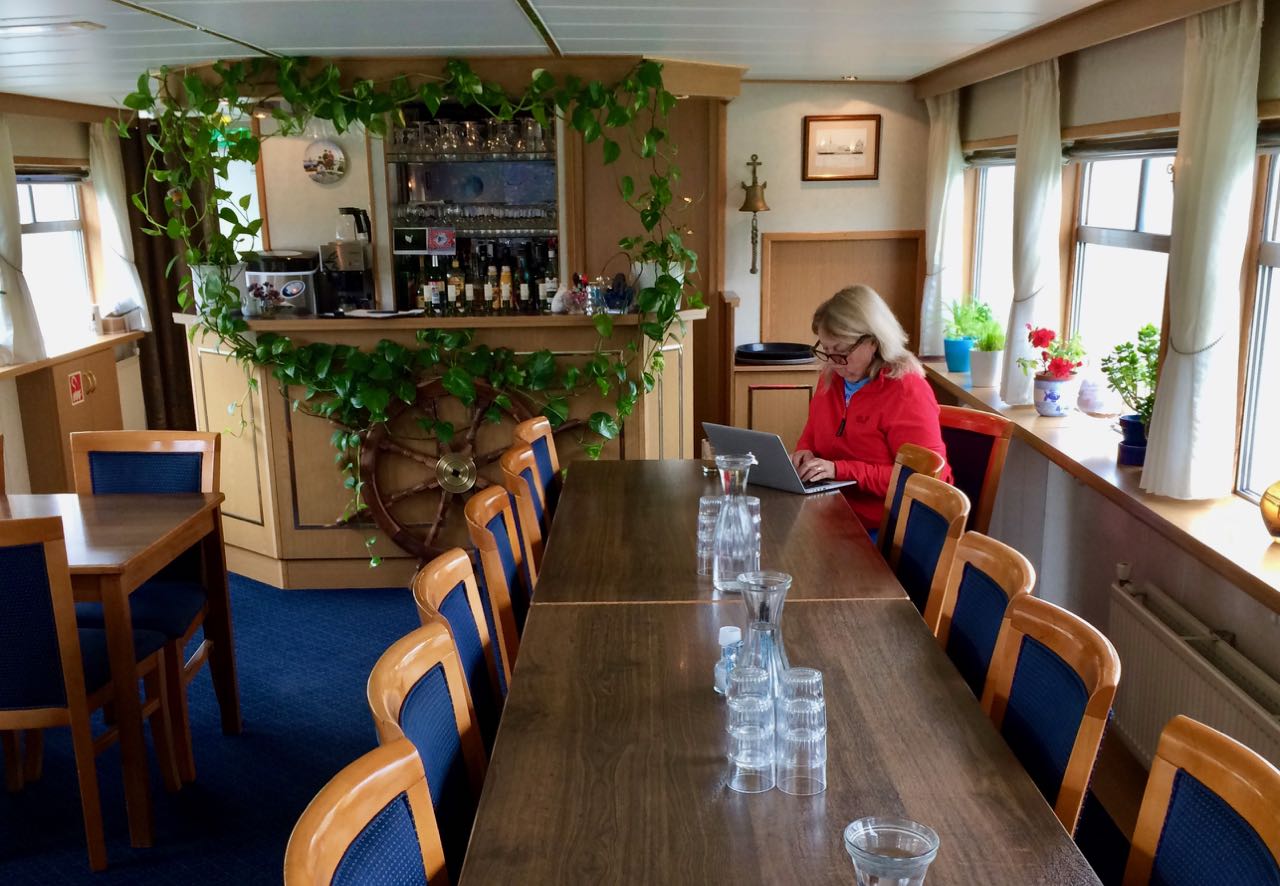
IMG_1498

A Moment to Write

Modes of Travel

On a bike-and-barge trip, two relatively unusual forms of transportation combine to form a symbiotic touring technique.  For people who “live on the canals” (think captain of the barge), there is another combination: car-and-barge.  Although it is possible to zip into town to shop for groceries on a bicycle, obtaining food for approximately 30 people is best done in a more substantial vehicle.  It is not too difficult to imagine a barge with space for 30+ bicycles on the top deck, but the idea of a car on the stern is a bit odd.  Think: load & unload every day.  Bicycles every day (good exercise), car on occasion…

a crane
a crane
for a car
for a car

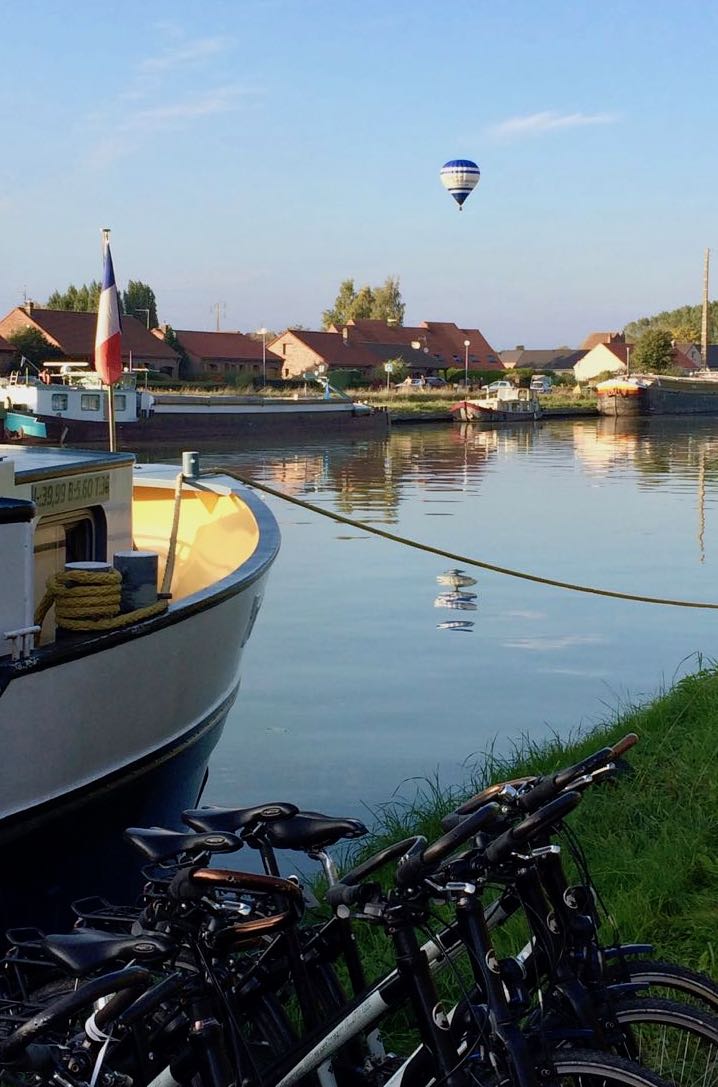
For tourists, part of the marvelous history of Europe is centuries of art and architecture.  But, Europe has a history of innovation in virtually every form of transportation, including hot air balloons.   The picture below captures an interesting intersection of methods of transport.

IMG_1524_v2

a Balloon

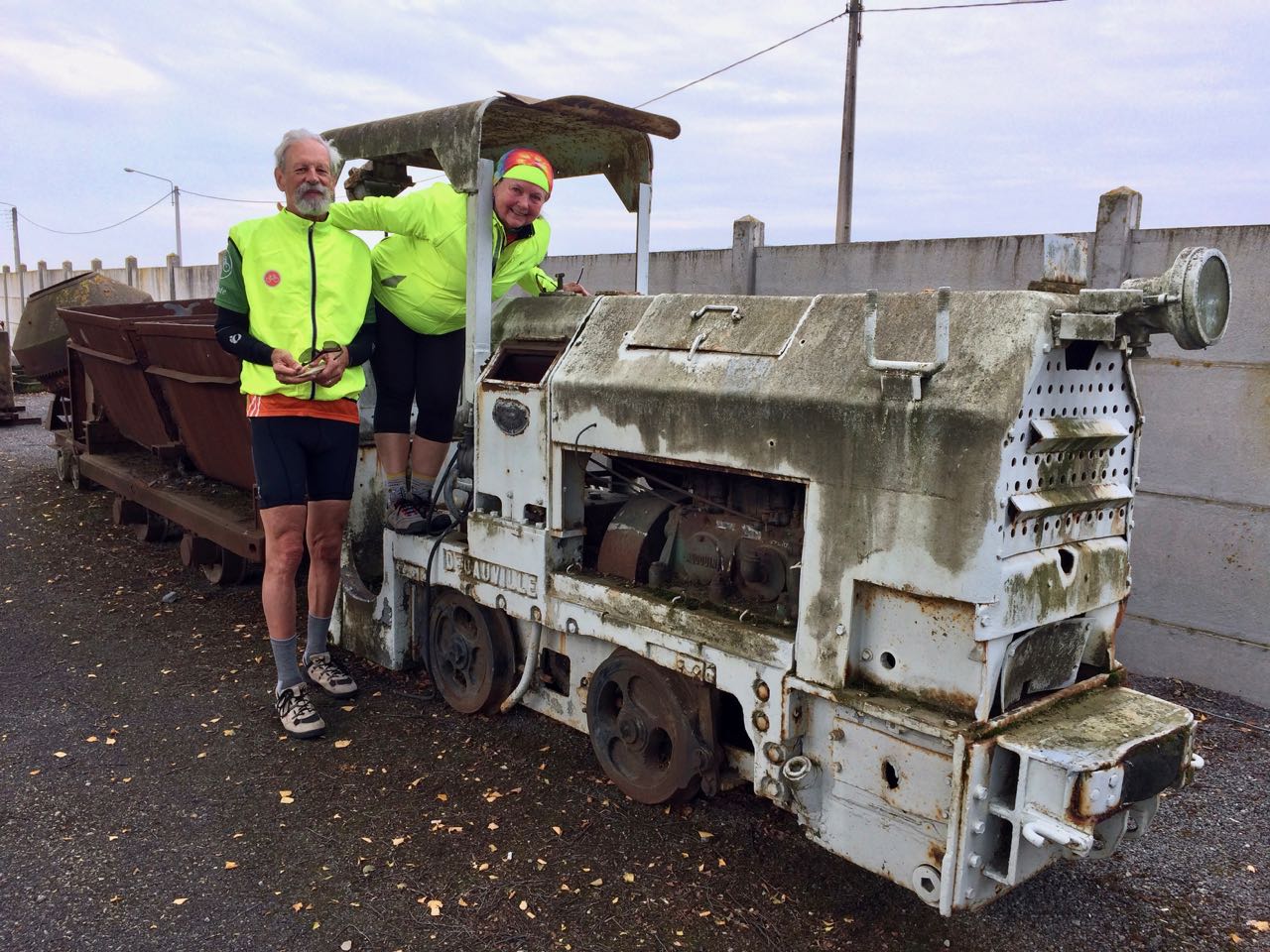
Our most unusual transportation mode was underground mine train.  Although most of our travel was in small towns or picturesque countryside, France and Belgium played a vital role in the industrial revolution.  Like significant parts of America, European regions form a “rust belt.”  The mines, built when the reliance on coal as a source of fuel and power was vital, are now closed.  To understand fully the role played by this historic moment, there is a Mining History Centre, located at the heart of the coalfield, at Lewarde in the Nord département of France.

As mankind proceeds into an increasingly post-industrial age, issues of employment and re-use of old facilities requires societal re-engineering.  Multi-national perspectives seem invaluable.

mine train

a mine train (Joy & Murph)

Into Belgium

Fortified with the last stop at a French pâtisserie, we crossed into Belgium.

French pastries

Yum!

As we approached Belgium, our guide explained that the once-significant passport crossing had been replaced with a mere sign to demarcate the border.

“I was sure this was the place,” he said as he circled back.  Several long loops.  No sign.  Gone.

An absence can have great significance.  100 years after the Great War, the border between France and Belgium is unmarked.


Tournai

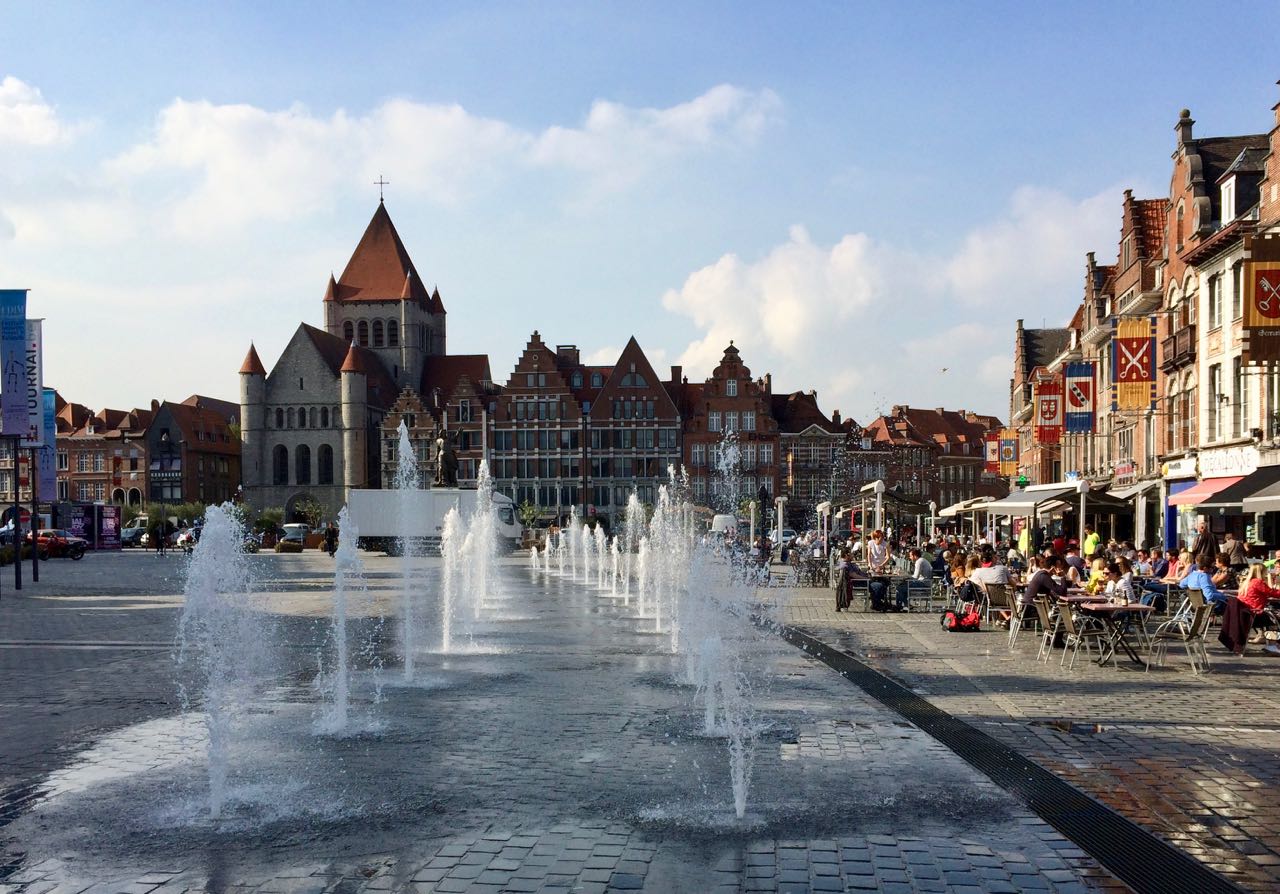
Our first city in Belgium was Tournai – with a lovely modern fountain amid a vast selection of food and Belgian beer within the old city square.

Version 2

The Square

Our barge was moored on the Scheldt (Escaut) river for the night.  It had squeezed through the Pont des Trous, a vestige of medieval architecture, during our ride.

night bridge

Bridge at Night

It was in Tournai (or, a nearby town (delays in blogging can skew one’s memory)), that we encountered another type of delay.  We were informed one evening that breakfast, always at 8:00 am sharp, was to begin at 8:30 am on the following day.  “Why the delay?” a rider asked.  “The bakery in this town does not open early enough to buy bread in time for the normal breakfast,” we were told.

Of course, I thought: day-old bread – normal in the U.S. – is a sacrilege in France or Belgium.

It was that way many years ago:

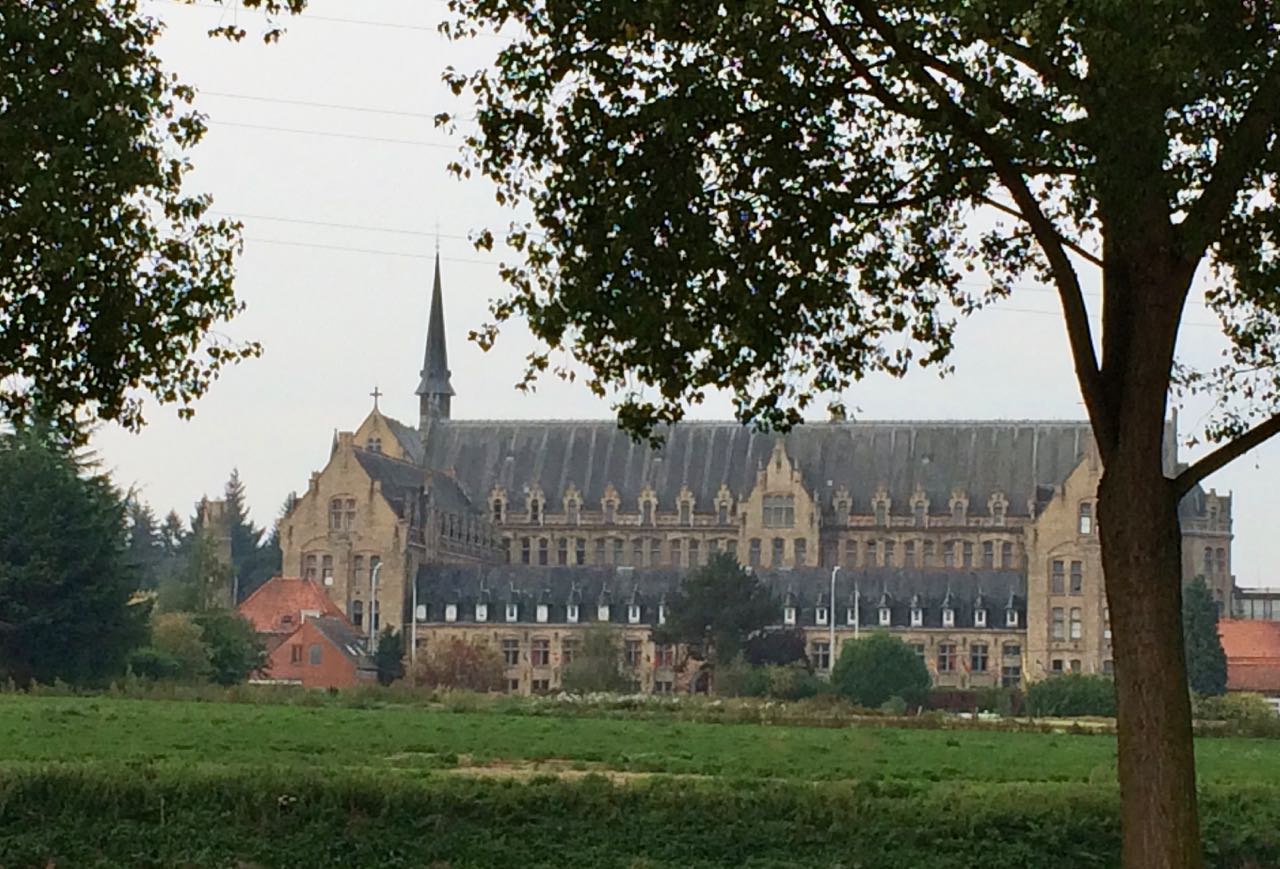
IMG_1586

an Abbey by the Scheldt

And, it will be that way after the last bike rider is gone.

IMG_1589

Last One…


Beyond Paris: Riding

11 Saturday Nov 2017

Posted by 2wheels2travel in Uncategorized

≈ Leave a comment

Another delayed posting.  I could claim that I waited for Armistice Day (c.f. below) – but, really I was just too busy with reflection…

Into the Countryside: Simplicity of the Past.

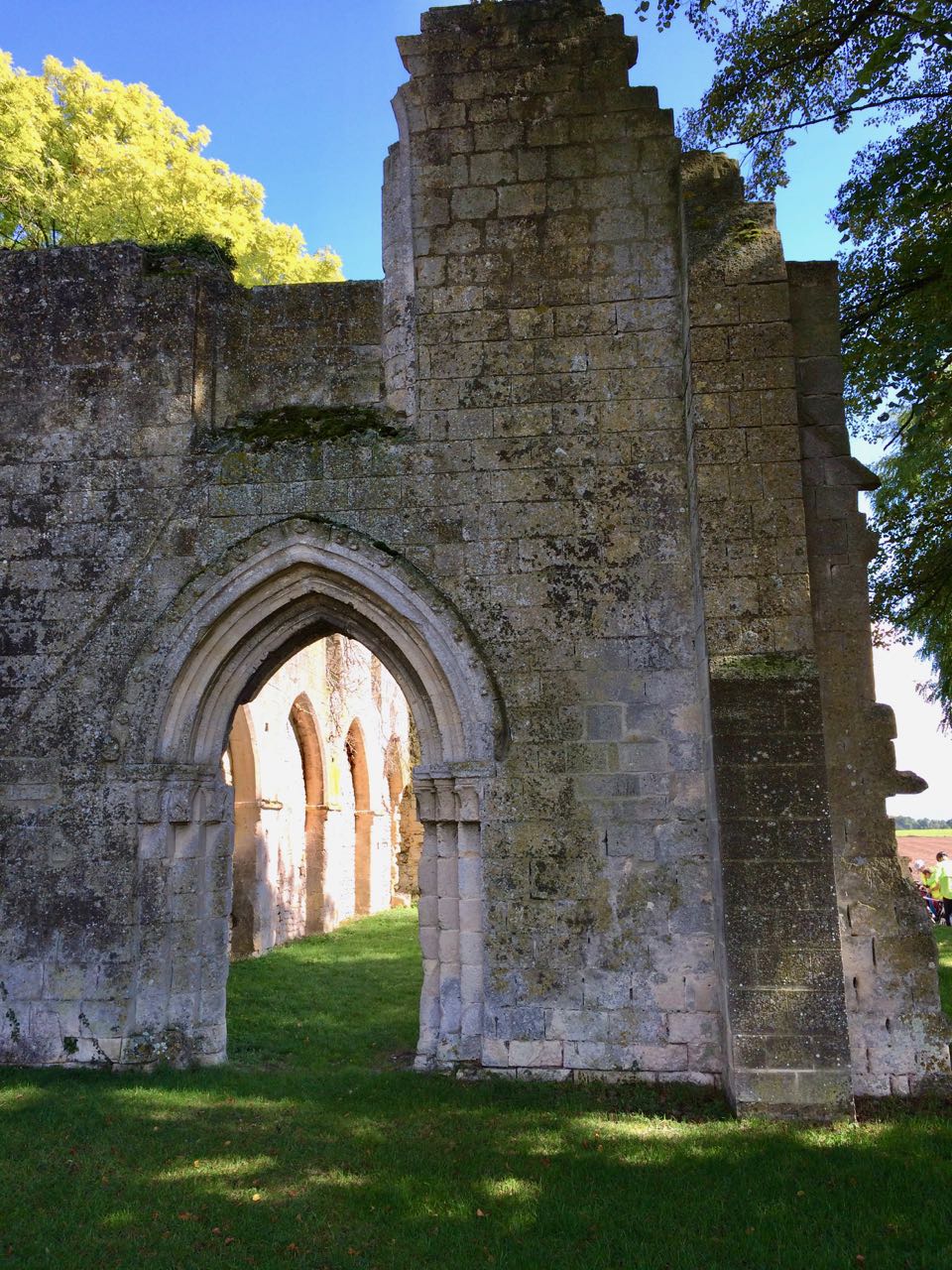
Not every magnificent Christian edifice has withstood the test of time.  Impermanence is an aspect of all humanity’s endeavors.  Occasionally, deterioration leaves behind evocative mysteries of a past place of worship.

At St. Jean-aux-Bois & Compiègne, the remnants of a 12th Century church provided a lovely stopping point for lunch on a pastoral ride.

12th C Church

12th Century Church

Not far from the secular remains of an earlier millennium: a Roman amphitheater and bath.

Roman amph

Roman amphitheater

Roman bath

Roman bath

Of course, not every old church is in ruins.  By celebrating simplicityThe Benedictine Order avoided some of the deterioration that seems to have resulted from the extravagant and ornate adorning of other religious buildings.

Benedictine church

Benedictine church

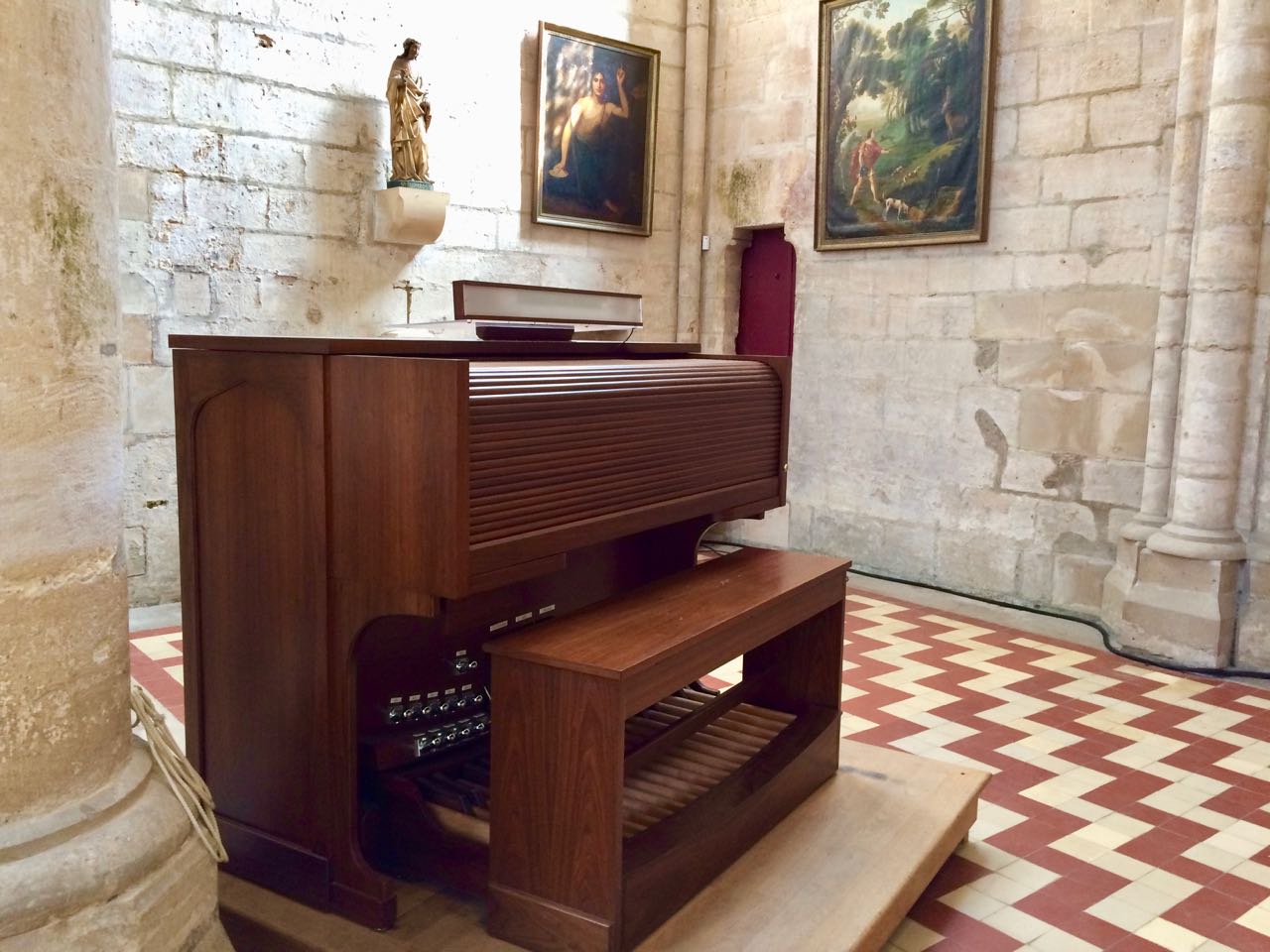
And, in keeping with the age of iTunes – a new organ for the current visitors to the ongoing place of worship.

Benedictine organ

new organ


More Countryside: Riding into The Past Century.

As may seem obvious, this blog is less chronological and more psychological.  (Indeed, the delayed postings are the result of an avoidance of deadlines.  The thrill of retirement.)

Now that I have more time and space to spread out, I seem have too many “local” commitments.  However, I can still vividly recall the wonderful exploration of France & Belgium on a barge with delightful fellow bicycle riders.

Living on a canal boat is a mixed blessing.  A true blessing in that, despite a minuscule kitchen the food was Cordon Bleu quality.  But, the daily schedule was rigorous – the activities of daily living were hard in a cabin that, although clean and neat – felt not much larger than a comparable space in a submarine.  And, for those of us 6’ 4”, a “bathroom” that is 4’ X 4’ X 6’ 5” is rather cramped. (Smaller than my closet at home)  And, a bed that is 6’ 4” is quite cramped.   Consequently, it was hard to create and upload thoughtful comments without space and without consistent WiFi.

Sadly, living in close quarters had other disadvantages.  When the trip began, a few folks had a slight cold + cough.  As I sketched this entry – 10 days into the trip – about 6 people had stopped riding due to illness.

However, one of the advantages of a bike-and-barge journey is that rather than ride when sick, people can create a floating infirmary – and, heal.

Our discomfort paled as our rides through rural France reminded us of the excruciating protracted horror that was the Great War, World War I.

In the Forest of Compiègne we encountered the war memorial commemorating the signing of the armistice where World War I finally ended.

IMG_1450

Armistice monument

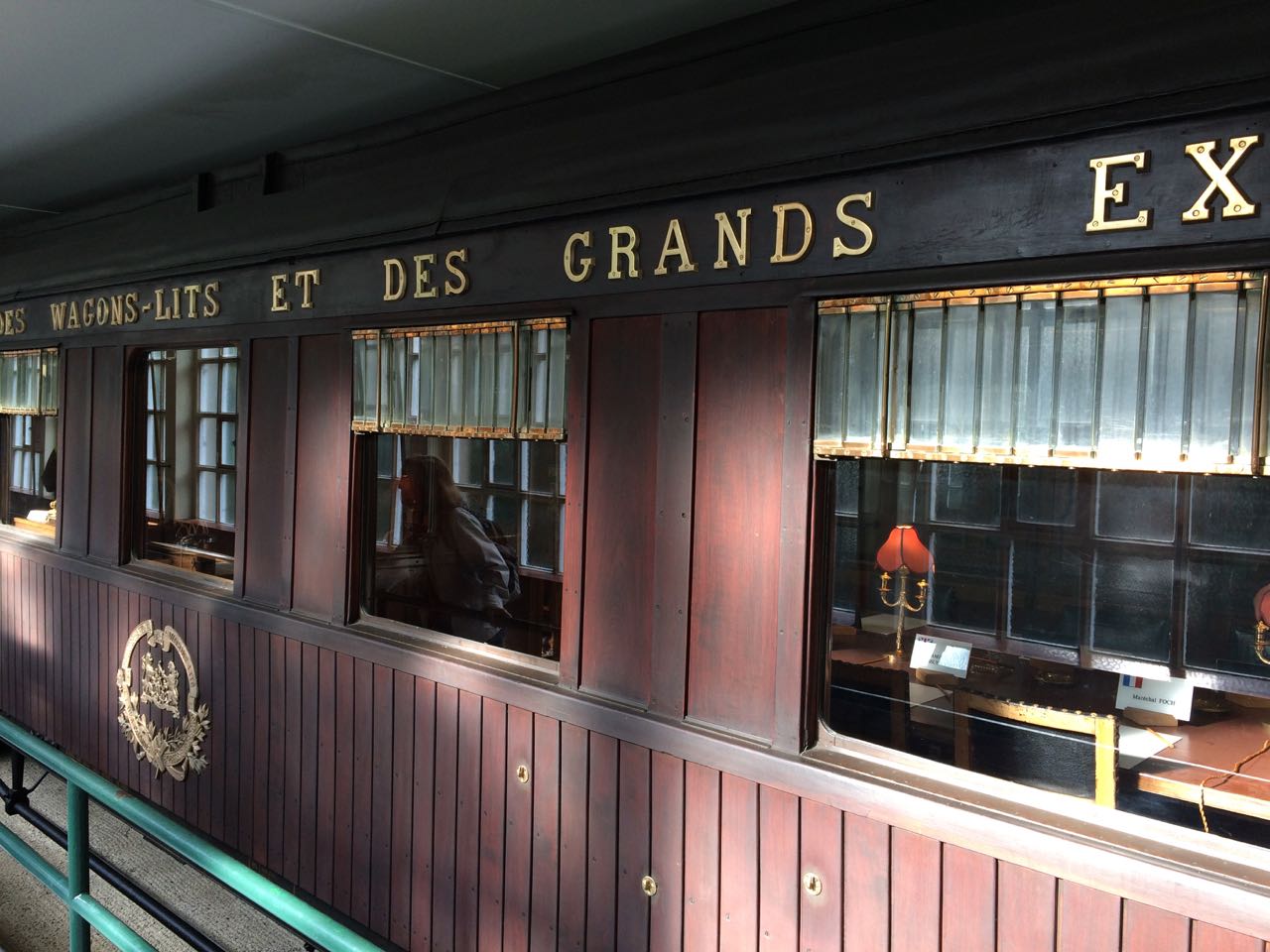
The war memorial contains a reproduction of the rail car where the armistice was signed.

IMG_1451

Railroad car reproduction

And, artifacts that bring to mind the nature of the war.

IMG_1454

WW 1 tank

From the New York Times (old and new) come observations about the nature of man’s inhumanity to man:

1111_big_top

Front Page: NYT

Known then as the “Great War,” World War I was also described as the “war to end all wars,” because many believed its high death toll and vast destruction would deter future fighting. This, of course, did not hold true. Because of resentment over the terms of the Treaty of Versailles, the National Socialist German Workers’ Party and its leader, Adolf Hitler, rose to power in Germany, seeking to avenge Germany’s defeat. After invading and defeating France in 1940, Hitler ordered that the French sign an armistice in the Compiegne Forest in the same rail car where the World War I armistice was signed.

More recent NYT observation (2011)

Travel in Europe can provide images of great beauty and emotions of great sadness.

Barge Navigation Note:

For me, no description of a BAC bike trip is complete without some mention of Navigation.

On non-barge trips, the exact itinerary is set well in advance.  Day 1 starts at hotel-1 in town-1.  Next day, we ride ’n’ kilometers to hotel-2 in town-2.  Repeat for 14 days.  Or 12 days, if the trip includes two rest days – one rest day in town-x, second rest day in town-y.  Obviously, hotel reservations need to be made by the trip leader months in advance.  Consequently, riders can have Cue Sheets (“Starting at hotel-7, ride 0.5 kilometers North; turn Left onto Rue des Pavés…”) and/or maps which show the route from a “Google map / Michelin Map” view – and, perhaps, even a GPS file.  All formats describe a predetermined route.  Note: there are generic GPS standards (Open Geospatial Consortium) – but, each of the many navigation devices may have a proprietary file format.  And, few devices can use “the other guy’s” format…  (refer to GPS details on BikeRadar.com)

best-gps-Radar

from BikeRadar.com

On a barge trip, the itinerary needs to be flexible.  Barges travel through narrow canals.  Barges queue up for access to very narrow locks that accommodate changes in elevation.  (Think: mini Panama canal every ’n’ kilometers,,,)  And, canal traffic happens. (I live in Atlanta…  Let me tell you about traffic…)

Although each bike-and-barge tour has a default itinerary, adaptability is a natural component of all travel.  Our schedule had been imperfectly communicated to the captain of the Zwaantje (the thrill of working through an intermediary travel service) – and so, significant changes were made on the first night as we discussed where we would travel each day.

So, how does one create Cue Sheets | Route Map | GPS files for a unique route – re-designed on day 1 – that may change on-the-fly?  (Remember: canal congestion and delays…)

Not possible.  So, our trip included a staff of 6.  Four folks to do the boat: a captain, his wife, an engineer, and a cook.  Two folks to lead each ride.  The ride leaders were graduate students who alternated as Ride Leader and Sweep.  All 24 riders kept the same pace as we were guided on each day’s journey.

That is – as BAC folks know – not the usual approach to a two-week ride.  The advantage of pre-planned routes is independent navigation.  Often there are several groups based on speed: the quick ones; the moderate paced riders; and those travelers who want to stop and smell the flowers (and, take close-up pictures of the sunflowers that look like the ones that Vincent Van Gogh painted…).

Not this trip.  A single line of riders.  Think Tour de France peloton traveling relatively slowly.

But, a benefit of group cohesion was knowledgeable talks from our well-educated ride leaders at break points.  Descriptions and histories of specific towns and cities; stories about the original inhabitants of that special chateau; insight into the origins of a place of tranquility…

IMG_1690

A beguinage, from the French term béguinage, is an architectural complex which was created to house beguines: lay religious women who lived in community without taking vows or retiring from the world.

Every journey provides unique perspectives and rewards.

Paris to Bruge: September 16 – 30, 2017

20 Friday Oct 2017

Posted by 2wheels2travel in Uncategorized

≈ Leave a comment

As is clear from the “Blog dates,” this is not a real-time effort.  A European bike trip takes 100% of my energy.  Days are filled with riding, socializing, taking a few pictures, and the activities of daily living – all done in a dynamic and unfamiliar environment.  Writing requires reflection and edits…

Below are memories – enhanced and modified by a return to a more quiet space.

Paris – Sophistication and Simplicity.

After an easy high-speed train ride from Amsterdam to Paris (passing Van Gogh’s fields of complex colors), we arrived at our home for the next two weeks: the Zwaantje.  And, our twenty two fellow bike companions.

We had a bit of time to configure each bike with our own pedals and saddle.  And, a quick spin around the dock along the Seine – at the Quai du Bercy.  “Yes,” I thought, “a sturdy Dutch bike.”  “Not as light and nimble as my own bike, but should be OK.”  Little did I understand how vital a sturdy bike would be on varied terrain: from cobblestones in historic cities to single-track paths through national forests.

cobblestones

Belgian Block on Charles Lane. Credit: Barry Munger

The next morning we started our daily routine on our canal-sized barge:

  • Breakfast at 8:00 am (lovely, despite a tiny kitchen);
  • The start of a ride (~50 kilometers);
  • Dinner at 6:30 pm (astonishingly cordon bleu, despite a tiny kitchen)

We could have started with a comfortable ride along the Seine.  However, there was a rowing competition that Sunday.  So, we were relegated to the cobblestone path with the joggers, the strollers, and the dogs.  (Dogs and bicycles do not always mix well…)

Riders on the Seine

Notre Dame

Soon we were riding through the posh suburbs of Paris.  As usual, building mutual support among the riders.  “Watch out for the dog.”  “Mind the steel post that prohibits car traffic…”

In an urban area that is constantly undergoing renewal, there are often Construction Zone road surfaces: gravel, potholes, narrow passageways… And, dogs.  Consequently, a few minor falls, but no serious injuries.

Yes, it is possible to bike past the Eiffel Tower.

Eiffel Tower with riders in foreground

Wrong time of day…

Yes, it is possible to bike past the corporate headquarters of Louis Vuitton.

odd architecture

Nouveau Whimsey

A short day of about 30 kilometers – and, back to our floating home before the serious rain began.   A glass of wine and the camaraderie of shared experiences.

Beyond Paris – Simplicity and Extravagance.

Part of a bike trip is, of course, riding bicycles.  Part is an effort to understand and appreciate another part of the world and unique perspectives.  Our next day began in Auvers-sur-Oise.  It is the small French town where Vincent Van Gogh did his final paintings – where he formed his last perspectives.

Note: bike folks do walk occasionally.  So, before our ride, we walked up the hill from the river to a church and a cemetery.

What would the church in the town where Van Gogh spent his last years look like to a camera?

simple French country church

The Church

What would that same church near the asylum where Van Gogh spent his last years look like to an inspired artist?

Van Gogh's version

A Vision…


And, nearby – the resting place of Vincent Van Gogh and his brother.

2 grave stones with ivy

Resting In Peace near the Church

His poignant efforts to refine – constantly – his vision, his technique, and his perceptions enabled Van Gogh to leave a legacy that will inform the visual arts for millennia. His two dimensional world will inform my sense of experienced reality for the rest of my life.

He kept asking the question that we all need to ask: “Who am I, really?”

6 self portraits

Courtesy: Van Gogh Museum


From artistic vision and the simplicity of a small town, we rode to a French marvel of vision and extravagance: the horse museum and the castle of Chantilly.

Castle in drizzle

Must see: http://www.domainedechantilly.com/en/

From the library to the private chapel, a work of centuries of development (and, of course, re-development) has evolved from the 16th Century.  Much of the vision is from Bourbon-Condé.  Gracious architecture, elaborate gardens (it helps to hire the former gardener of Louis XIV), and a celebration of the skills and knowledge of the nobility: horsemanship.

Not a bad spot to escape the tour’s most serious rain storm.  A lunch time deluge.

Time to admire a Renaissance library of great depth and breadth.

library

…not just a Reading Room

Time to admire a personal chapel of great beauty and reverence.

alter of chapel

a place for the family to pray

bas relief

Altar Detail: Abraham & son

A few more kilometers and time for wine and stories.


More Preparation

19 Thursday Oct 2017

Posted by 2wheels2travel in Uncategorized

≈ Leave a comment

Adjusting

One of the thrills of international travel is jet lag: adjusting to a time zone shifted by 6 hours. One way to prepare for two weeks of bike rides (30 miles / day) without complete exhaustion is to start a few days early.

And, if cheaper airline tickets are available in a nearby city (with high speed train travel to Paris) – why not depart a few days before and visit the most bike friendly city in the world: Amsterdam?

Bikers on Amsterdam bridge

Courtesy of Mike’s Bike Tours

And, what do to in Amsterdam but book a tour with MIKE’S BIKE TOURS?

With only mild exhaustion – and, a slight chance for reasonable weather, off we went.   A delightful time.

One of the advantages of bicycle travel is that it is possible to have a delightful experience in an unknown city with unique traffic conventions – and, intermittent rain.

bikers on the road

Courtesy of Mike’s Bike Tours

With an experienced tour guide, exploration becomes a street level view of a European city.  Newness itself is inspirational: it helps us see traditional realities from a unique perspective.  Of course, delightful people are vital.  Our spirited tour guide (an Amsterdam native) with boundless energy, extensive knowledge of the city, a enchanting goth appearance, and an effusive sense of humor, was a catalyst for receptivity to a vibrant culture.

Part of the culture – and, a solution to intermittent rain – was to stop for a break near the end of the tour, as the drizzle increased to honest-to-goodness rain.  At 11:30 am, I would usually pick coffee as a good beverage for a rain delay.   But, in the Netherlands, real bikers opt for a Kopstootje, a shot of Genever (Dutch version of gin with juniper berries and spices), washed down with a glass of beer, and (to cushion the stomach) a hard-boiled egg.

…when in Rome…

Amsterdam’s culture includes a population of 800,000+ people – and, 800,000+ bikes.  Old, new, well cared for, rusty and worn…  Single speed, old fashioned, new fangled…  A cacophony of two-wheeled vehicles – and, adept riders.  Only an adept rider could zip through complex traffic patterns while texting – and, survive.

biker with phone - texting

Texting without traffic

It helps to have a city designed and largely built before the age of the automobile.  It helps to have real city planning.  It helps to have land which is extremely valuable.  Nonetheless, it is astonishing to see a vibrant city where the primary modes of transportation are public transport and bike.

It would be a formidable stretch for most US cities to change from “bike as recreation” to “bicycle as transportation” – an integral part of getting to school and to work.

Or, just to become a destination for happy tourists.

Joy & Murph in drizzle

after a stop for Kopstootje

Beyond the Bike

Although It is wonderful to explore the world where bicycles are an integral aspect of life, European travel presents a world of experiences where art and history are always in evidence.

So, for Joy and for me, the Anne Frank House and the Van Gogh Museum were essential destinations in Amsterdam.

Anne Frank House

Compared to the Roman ruins visible from a bike in much of France, in contrast to the soaring gothic churches of a millennium ago, the horror of the Holocaust is recent.  My father served in Europe in World War II.  My work in Washington, DC enabled two visits to the US Holocaust Memorial Museum.

The visceral experience of a single family – a sensitive young woman with ambition, insight and charm, and her father (the sole survivor of the concentration camps) – should penetrate the collective soul of all mankind.  And, the enormity of the millions who died – all unique people with unique gifts to offer the world – should prevent future atrocities.

We humans are capable of extremes of both compassion and destruction.  The Anne Frank House images and significance – both extreme intolerance and sacrificial service – were a constant echo as our bike rides in France and Belgium unfolded during the next two weeks.

Vincent Van Gogh

Vincent Van Gogh’s visionary service to humanity was the underlying vision that I took from our visit to the Amsterdam museum that celebrates his extensive work.  In his short life he experimented with a path into the clergy – and, he strenuously labored to find new techniques to portray the inner realities of his unique visual world.  His collaborative work with other artists of his day showed a level of collaboration that seems frequent in the work of our best innovators.  His transition into a mental institution did not diminish the flow of his evocative sketches and canvases.  Only later, when we cycled past the fields that he painted, and when we visited his grave in Auvers-sur-Oise, would the majesty of his vision start to become fully evident.

Joy in from of sunflowers

Joy at the Museum


lovers in the garden

From the Museum Collection


Preparation – Another BAC Adventure

09 Saturday Sep 2017

Posted by 2wheels2travel in Preparation

≈ 1 Comment

What is the best preparation for Yet Another Bicycle Adventure Club tour in Europe?

Yes, after a hiatus of more than 24 months, we’re off to France for a 2 week bike-and-barge trip from Paris to Bruges.

Bike and Barge

Barge in front of canal houses

BAC trips are not spur-of-the-moment decisions.  Often made a year in advance, they involve financial preparation (even with co-op financing, European travel is not inexpensive).

Of course, part of getting ready is physical:

“For this ride, you should be able to ride ’n’ miles each day – comfortably.”

(Refer to Ride Rating System)

For those of us who are not bike commuters, and whose car-centric lifestyle is compounded by inclement weather, that means a conscious effort to spend more time in the saddle.  (Yes, I know, the British believe that there is no inclement weather, merely inappropriate clothing.  But, those folks live on an island in the North Sea – and, their concerns are wind, cold, and rain.  I live in Atlanta – and, there is a limit to the amount of clothing that is appropriate to shed in a Very Hot summer.)

Ultimately, travel is about discovery.  And, so preparation involves more than improving physical strength and endurance.  It requires knowledge of the territory ahead – and, conditioning for receptivity to new perspectives.  An openness to new knowledge engendered by a new destination.

How do we best ensure that we will return from our travels with an enhanced understanding of the world?

Wikipedia’s definition of receptivity is a bit overwhelming:

the term has both ontological and ethical dimensions, and refers to a mode of listening and “normative response” to demands arising outside the self, as well as “a way by which we might become more attuned to our pre-reflective understanding of the world, to our inherited ontologies,” thereby generating non-instrumental possibilities for social change and self-transformation.[1]

Wow.

For us simple folks that seems to mean trying to cultivate a “beginner’s mind.”

“When you bow, you should just bow; when you sit, you should just sit; when you eat, you should just eat.”

― Shunryu Suzuki, Zen Mind, Beginner’s Mind

Perhaps, when we travel, we should just travel.

But we educated folks need effective techniques to open our inner eyes.  Even if our physical eyes are dimmed by the years required to earn a Medicare card.

“I’ve got it,” I thought.  “I’ll visit my local environment as if it were new to me.”

And, as luck would have it, my home town was conducting its annual European-stye fete: The Decatur Book Festival.

(A disclaimer: when people ask me where I am from, I usually say “Atlanta.”  Even in Europe, I can add “CNN” or “Coca Cola” – and, the light bulb of recognition starts to glow.  But, my suburban Atlanta address is actually “Decatur.”  Too much to explain fully in a travel blog…)

A Beginner’s Mind on 2 Wheels

To make this adventure work, I would have to ride my bike to the Book Festival.  Like the bike-and-barge configuration, I would need a bike with at least 1 pannier, plus a small backpack for: raincoat (wet weather is universal); a camera (not just a smartphone with a lens); and a notebook (people with Medicare cards have fallible memories).

The bike ride would elevate my normal heart rate (much easier to drive to Decatur on a typical day).  The camera would force a new attentiveness on the visual world that I think I know well.  The notebook would remind me that verbal descriptions existed before the age of the selfie.

Bike in driveway

As a “Decatur-ish” person for 30+ years, I enjoy this Atlanta suburb with its rich diversity.  Yes, Atlanta is quite diverse for a Southern city, but Decatur has a reputation as the Most Diverse city in the U.S.  The fact that it hosts the largest independent book festival in the country gives some indication.

That impression was confirmed by one of the speakers – an author who lives in New York City: “Wow,” she said, “this looks like the liberal nirvana that we’ve dreamed about..”

But, how to capture this irreverent love of diversity for a Blog?

NO Poop Fairy sign

“Aha,” I thought, holding my camera – I’ll take a picture of the clever signs in front of the Decatur Library:

  • One proclaims that the entire city of Decatur is a “No Smoking Area.”  Try that in NYC…
  • And, the other uses gentle sarcasm to remind pet lovers to clean up after the beloved animal relieves itself.  “No Poop Fairy.”  (I wonder what a Poop Fairy in Brooklyn might signify…)

Anyway, the city seemed much more crowded than usual – both pets and people.

https://www.facebook.com/plugins/video.php?href=https%3A%2F%2Fwww.facebook.com%2FDecaturBookFestival%2Fvideos%2F10154406454328815%2F&show_text=0&width=560

DBF Video

Context and Vision

It was wonderful to see so many happy people in the shadow of the prominent 19th Century building in the center of the square: the Dekalb County Courthouse.  The building was constructed in 1898, its predecessor destroyed in a fire.  It was a pivotal point in Sherman’s capture of Atlanta in the American Civil War.

Dekalb County Courthouse with obelisk

Receptivity resonates with font-of-mind context.  Within the September 2017 American political frame of reference – the horror of Charlottesville, VA (and, President Trump’s functional condoning of racism) – it was hard not to feel a strange contrast to the joyful curiosity for the best new literature on display in Decatur.

In 1909, as other cities of the former Confederate States of America had done, Decatur added a monument in front of the Courthouse.  Not Robert E. Lee on horseback, not Jefferson Davis…  Just an obelisk to commemorate The War…  It could reference a lost way of life – an inhumane economic system.  But, it simply commemorates the courage of the soldiers of the Confederacy.

What should I take away from Decatur with my “new eyes?”  The early 20th century effort to memorialize white supremacy?  The current collegial celebration of the arts – literature and music?

Strains of folk music drifted into the Square from the Festival stage, the Gazebo:

musicians and crowd


Time to head off to another talk by another author, I thought.

Understanding requires both an open mind – and, some time for reflection.

Perhaps, in another 50 years, today’s young Decatur folks can look back with more insight.  They already hear a different drummer.

young black girl, dancing

← Older posts

Recent Posts

  • Back to Europe: More Ruminations
  • Why BLOG?
  • Why Travel?  (Version 2)
  • Why Travel?
  • Into Belgium: the Journey Ends

Archives

  • June 2024
  • December 2023
  • September 2023
  • August 2018
  • December 2017
  • November 2017
  • October 2017
  • September 2017
  • July 2015
  • May 2015
  • June 2012
  • May 2012

Categories

  • Bike Stuff
  • France 2015
  • Italy 2012
  • Philosophy
  • Preparation
  • Trivia
  • Uncategorized

Meta

  • Create account
  • Log in
  • Entries feed
  • Comments feed
  • WordPress.com

Create a free website or blog at WordPress.com.

Privacy & Cookies: This site uses cookies. By continuing to use this website, you agree to their use.
To find out more, including how to control cookies, see here: Cookie Policy
  • Subscribe Subscribed
    • 2wheels2travel
    • Already have a WordPress.com account? Log in now.
    • 2wheels2travel
    • Subscribe Subscribed
    • Sign up
    • Log in
    • Report this content
    • View site in Reader
    • Manage subscriptions
    • Collapse this bar
 

Loading Comments...