
Tags
amsterdam, cycling, europe, netherlands, new civilization, travel
Obviously, this Blog has become — not a real-time-travel-report of adventures on bikes — but a series of commentaries on Travel as Adult Continuing Education. (Or, Adult Remedial Education, for those of us who are trying to learn more about Western Civilization before it’s too late …)
Pre-travel
Part of any anticipated adventure involves planning: where to go, where to stay; what to see; fellow travelers … For this undertaking, we did another 2-part Tour-de-Joy.
(cf. Iberia …)
The first part was an instance of this Blog: a 1-week Bike-and-Barge trip around Amsterdam. Our previous Bike-and-Barge trip (pre-Pandemic in 2017 with the Bicycle Adventure Club) was a 2-week trip from Paris to Bruges. Great fun! Hugely informative.
“We could organize a Bike-and-Barge trip, ourselves,” Joy enthused. “We could contact Tripsite, and recruit some of our Atlanta biking buddies to join us!”
Even though biking in Atlanta is complicated by heat and hills, we have enough bike enthusiast friends to fill a cycling barge in the Netherlands! Soon we had booked the entire (13 person) Zwaan for an 8-day tour: May 2 – 9.
Some people were fine with a 10-day trip — arrive a few days early; get adjusted to the time zone; see a few Amsterdam museums; do the tour; head back to Atlanta. Some of us wanted to extend our European sojourn: another country / tour / adventure …
The second part of the travel for Joy and for me was a week in Rome: a chance for Joy to do research for her historical fiction novel about aspects of WW II in Rome: Mussolini and his mistress, Claretta Petacci, fictional characters from the Ghetto …)
A tale of two cities — literally. The connection being that both were profoundly involved in the Second World War and efforts (or, lack of efforts) to live in peace with the global community; and in urban planning (or, lack of planning) to create cities in harmony with the natural world.
Planning v. Good Fortune
At the top of this Blog entry, I mentioned Western Civilization, but really, we have a global civilization in the 21stcentury. To our surprise, the Nieuwe Kerk (New Church) which was just around the corner from our hotel had an extraordinary photo exhibit: “The Stories That Matter – exploring the issues and narratives shaping our world through the eyes of photojournalists and critical thinkers”.
People who study Western Civilization may think of churches as places of worship — a font of Christianity. But, not in the modern era:
For decades, De Nieuwe Kerk Amsterdam has been known for its high-profile exhibitions about art, photography, and inspiring individuals and cultures. With an average of 150,000 visitors a year, the church is one of the most popular exhibition venues in the Netherlands. It also plays a role of national significance, hosting royal ceremonies, official gatherings, and cultural events.
One of Amsterdam’s oldest and most impressive historical monuments, De Nieuwe Kerk is a place of inspiration, commemoration, and celebration at Dam Square, the heart of Amsterdam. https://www.nieuwekerk.nl/en/de-nieuwe-kerk/
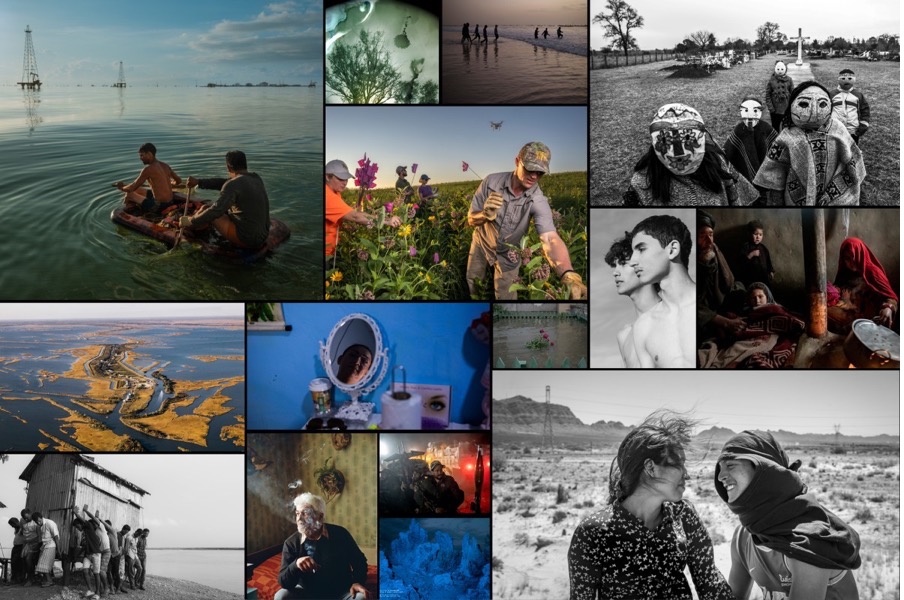
Given the theme: “The Stories That Matter,” much of the exhibition was images of war and economic injustice caused by climate change.

Extraordinary content for a building originally dedicated to the worship of God. A fitting introduction to part of our Amsterdam experience: the Resistance Museum and the new Holocaust Museum. On our previous visit to Amsterdam, we visited the Anne Frank House — a memory that still reverberates.
International flavor of Amsterdam: taxi driver from Uzbekistan; Spanish waitress in a Middle Eastern restaurant; a canal tour with two guides: Italian and Egyptian … A Tapas restaurant … And of course, a ‘n’course restaurant featuring Rijsttafel: The Dutch-Indonesian Rice Table.
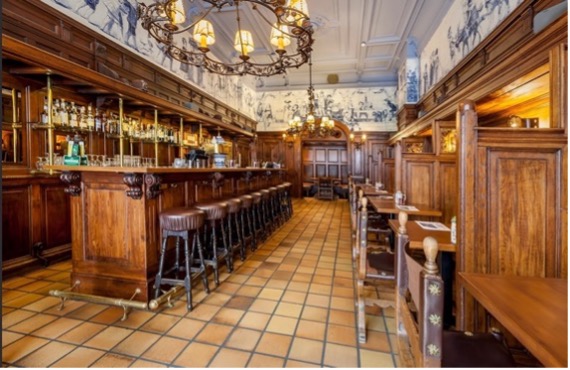
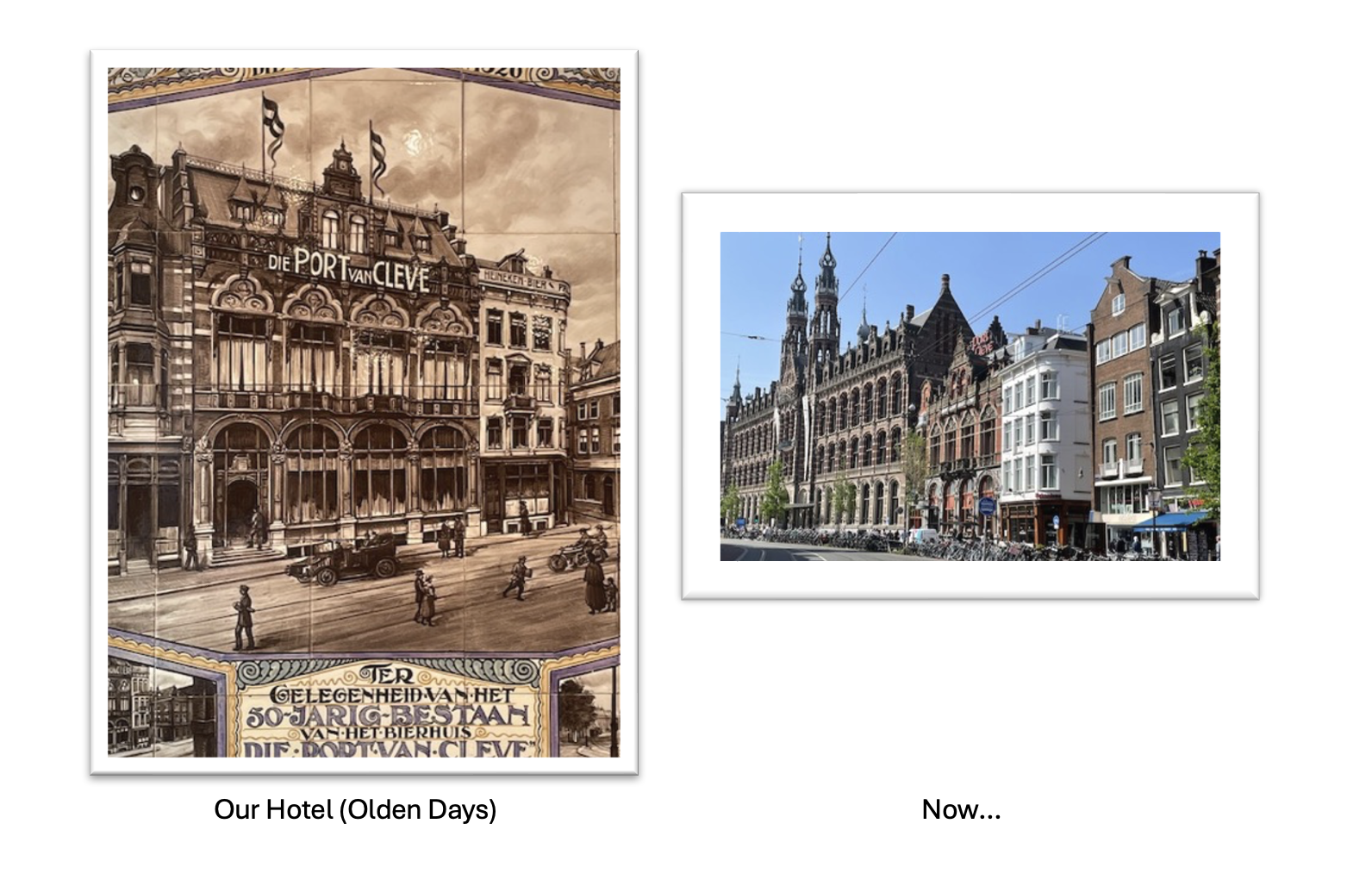
Our hotel, Die Port van Cleve, just off Dam Square, was a delight, celebrating its 150th anniversary. Bar Bodega – de “Blauwe Parade” is a traditional Amsterdam bar full of tasteful beers, jenever, and history, including the largest Delft Blue tile tableau!
Off to the Barge
More could be said about Urban Planning in a nation where 40% of the country is not just planned but created! Build originally for pedestrians and floating vehicles, Amsterdam is now comfortable for the “15 Minute City” lifestyle: pedestrians, bikes (!), and functional public transportation. Yes, there are automobiles, but mercifully few.
After checkout from our charming hotel, a relatively easy (with suitcases and backpacks!) tram ride to the Central Station. (Hooray Rick Steves’ minimalist packing list.)
What should have been a relatively easy (with suitcases and backpacks!) walk to our barge was a bewildering mess … Changes to pedestrian paths and ongoing construction confused Google Maps. Ugh. An astonishingly pricey taxi ride and presto — our new home for 8 days.
Good News:
- Relatively spacious rooms (this is still a barge, but OK++);
- Clear orientation to the process of Not Getting Lost with just a guide and NO sweep;
(details below …) - Clean helmets and panniers, new water bottles,
- Charming crew;
- Short orientation ride after short barge journey to rural biking spot ;
Bad News:
- Dutch-style bikes.
On our previous Bike-n-Barge trip, the bikes had been US-style hybrids. Seat and handlebars at approximately the same height. A familiar forward lean.
Dutch-style bikes force the rider into a much more upright position. Higher handlebars with flared back grips.

Turning a bike that has a unique configuration is a learned behavior. How much time to learn a new set of reflexive moves? I don’t know. It’s not a binary transition — one improves over time. But the need to learn quickly was apparent on the first day.
Although most rural roads are straight, they are quite narrow. (Remember, almost every square centimeter of land was created with significant effort.)
Although these narrow roads would be one-way-only in the US, they are actually two-way traffic throughfares. (Throughfares for bikes and motor scooters and a few motorcycles.) Which means, when you see oncoming traffic, you need to get the wheels of your bike as close as possible to the right shoulder of the path, quickly.
And of course, if someone is passing you (think motor scooter or motorcycle or Dutch bicycle rider), you need to move all the way to the right-hand edge of the narrow path, quickly.
And, beyond worrying about the edge of the path (usually wet grass, sloping down to the water in the canal), there was a question as to the Goldilocks’ space behind the bike in front of you. Too close and you crash if the person in front stops quickly. Too far and you may be all alone after a turn …
So, since this is — originally, a bike Blog — it’s time to explain the trick to Not Getting Lost with just a guide and without an experienced sweep who knew the route (technique on our first Bike-n-Barge trip). Yes, there was a sweep, but that person was one of us, a new volunteer each day. And that person stayed at the back of the line of riders.
At each turn in the road, (actual left/right turn, fork in the road, intersection within a roundabout …), Arie, the guide would yell “Corner.”
The person behind him would stop and point out the direction of travel to each subsequent rider, until the sweep appeared. Then, he/she would become the next-to-the-last rider in the pack, just in front of the sweep.
Throughout each ride, each of us would move closer to the front, and — usually — become a Corner at some point. (On a day of dense navigation in urban areas, you could be a Corner more than once.)
The technique worked reasonably well. Especially after the first day, when there was some confusion about who the sweep really was: the person who volunteered, or the person whom Arie had designated.
Despite some days with an attenuated line of riders, no one became lost or abandoned. But, as with any form of travel, dynamic changes (construction / washed out canal segments …), last month’s route may not work today. So, Arie used the GPS function of his phone and conversations with local folks to refine our path as he went. (So much for Cue Sheets for independent-minded bikers.)
On a conceptual level, the “Corner” technique reminds us of the nature of community: we are all each other’s helper; we need to perform social guidance roles as needed — the Golden Rule for a bike Peloton in a novel locale.
So, What Did We See?
We, is an interesting pronoun. Just as this idiosyncratic recollection is unique, each person had — I suspect — a separate experience. Partly, a result of How Many Days Riding.
Some people rode all 7 days. I rode 5. Joy rode 4. One person rode 2.
Partly, a result of How Many Falls. Remember, Dutch bikes with a demanding learning curve.
Some of us did not fall. (Applause, as I pat myself on the back …) Some had 1 spill. One person had 3 minor crashes. She was the person who rode just two days. Combining all the various mishaps: 10 falls. Significantly more than the average tour.
We all saw, no matter our degree of cycling, a verdant, nation, extending into the North Sea, through brilliant hydraulic engineering and common purpose. A nation, more diverse in Amsterdam than in the small towns. A nation without apparent poverty, having transitioned from a mighty colonial power to a prosperous modern nation with an educated population.
I was too busy to post on Facebook (I don’t do that anyway; I occasionally post on Instagram), but again, too busy … And, even with okay Wi-Fi on board, no Blog posts.
Much more interesting to spend time chatting with fellow riders, enjoying great food (a Scottish cook, who shopped the local markets each day!), good wine, and local beer — plus haunting memories of the Resistance Museum.
The Nazis were not tourists in the Second World War. And, the Dutch, with a still strong global economy, knew that by selectively flooding parts of their country, they could prevent the influx of Panzer tanks and Hitler’s infantry. They had not conceived of hordes of paratroopers.
They were confronted, like most of Europe, with horrible choices during the time of occupation. The Resistance Museum provides context and an inspirational view of the sacrifices made by many valiant people in the Netherlands.
On the Canals

Classic:

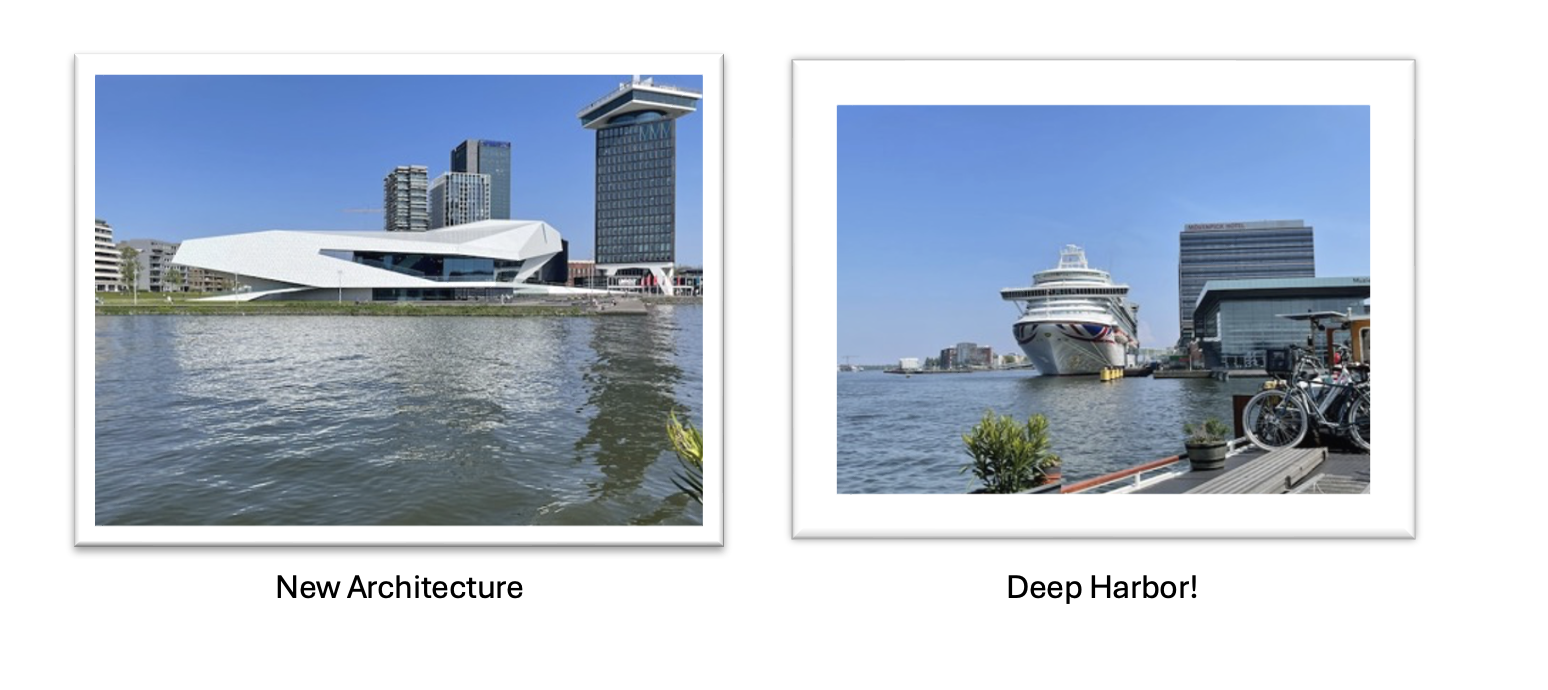
As Our Barge Traverses the Harbor
Day 2 — a rest day for some
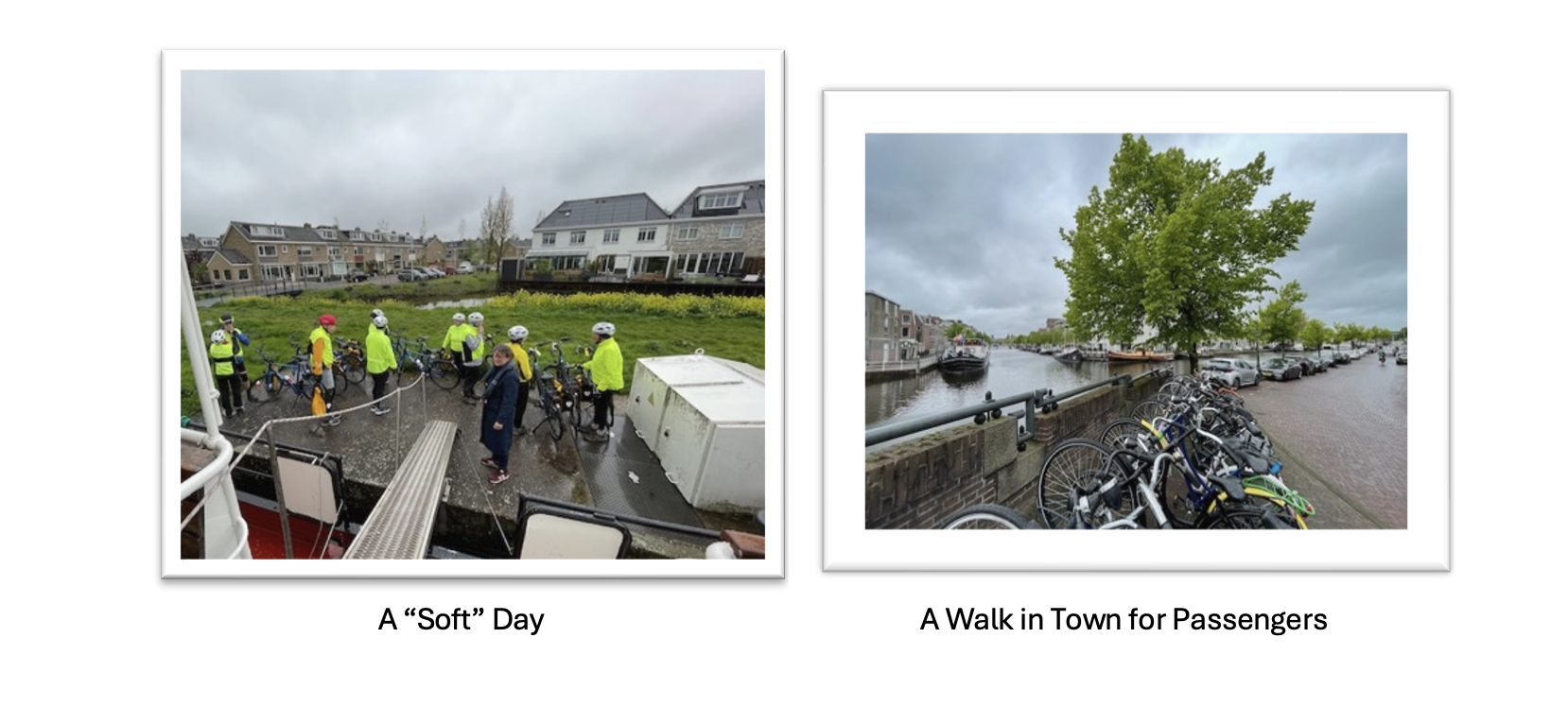
Day 3 — the countryside


Break Time
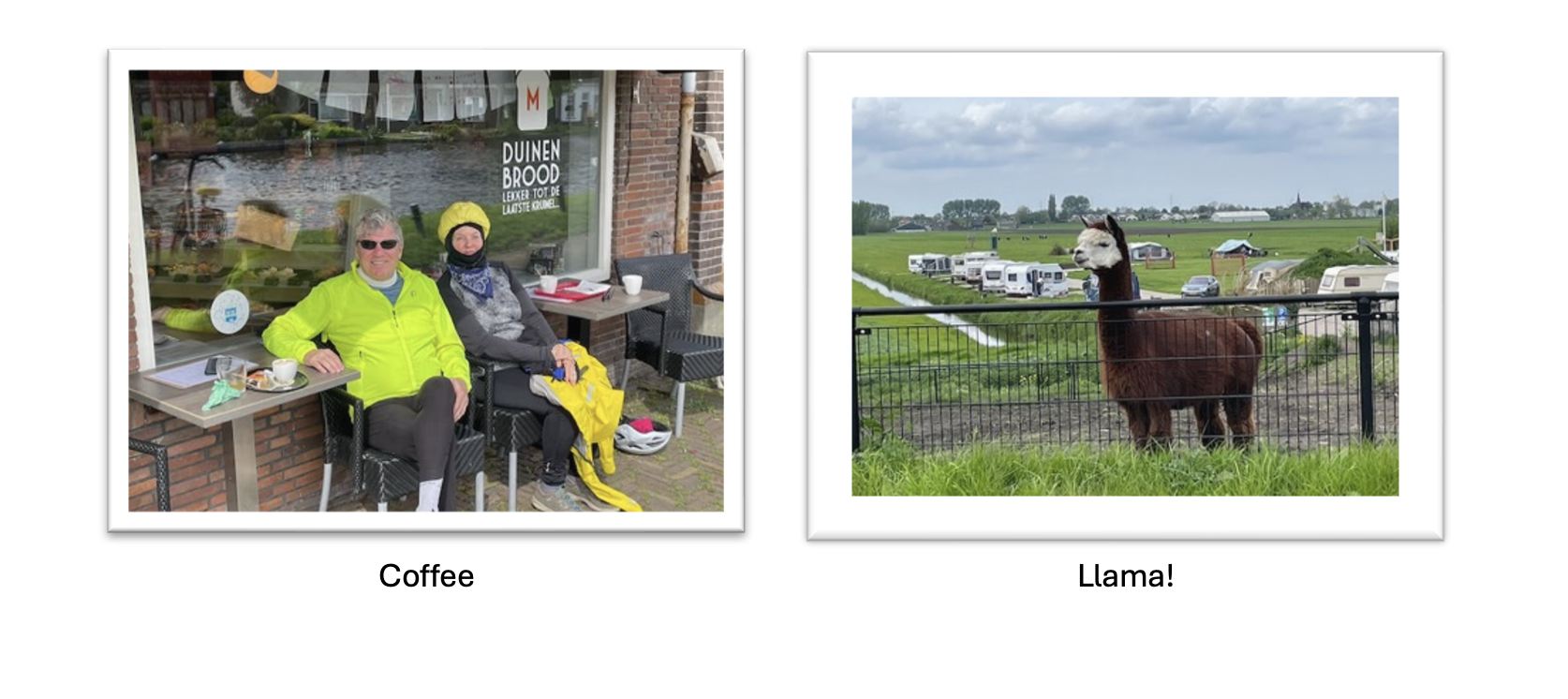
Lunch Break
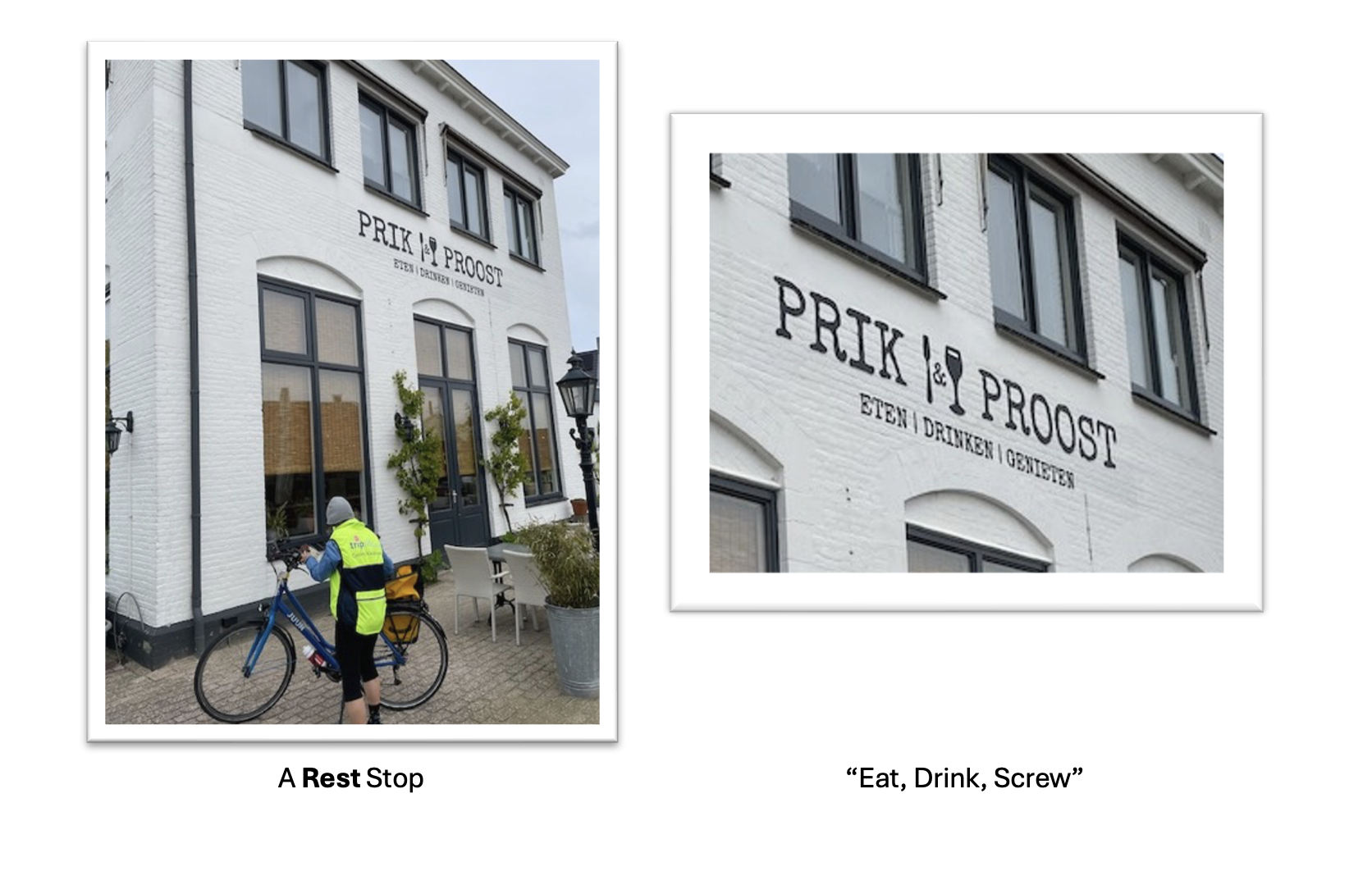
Oh, yes — Fields of Tulips

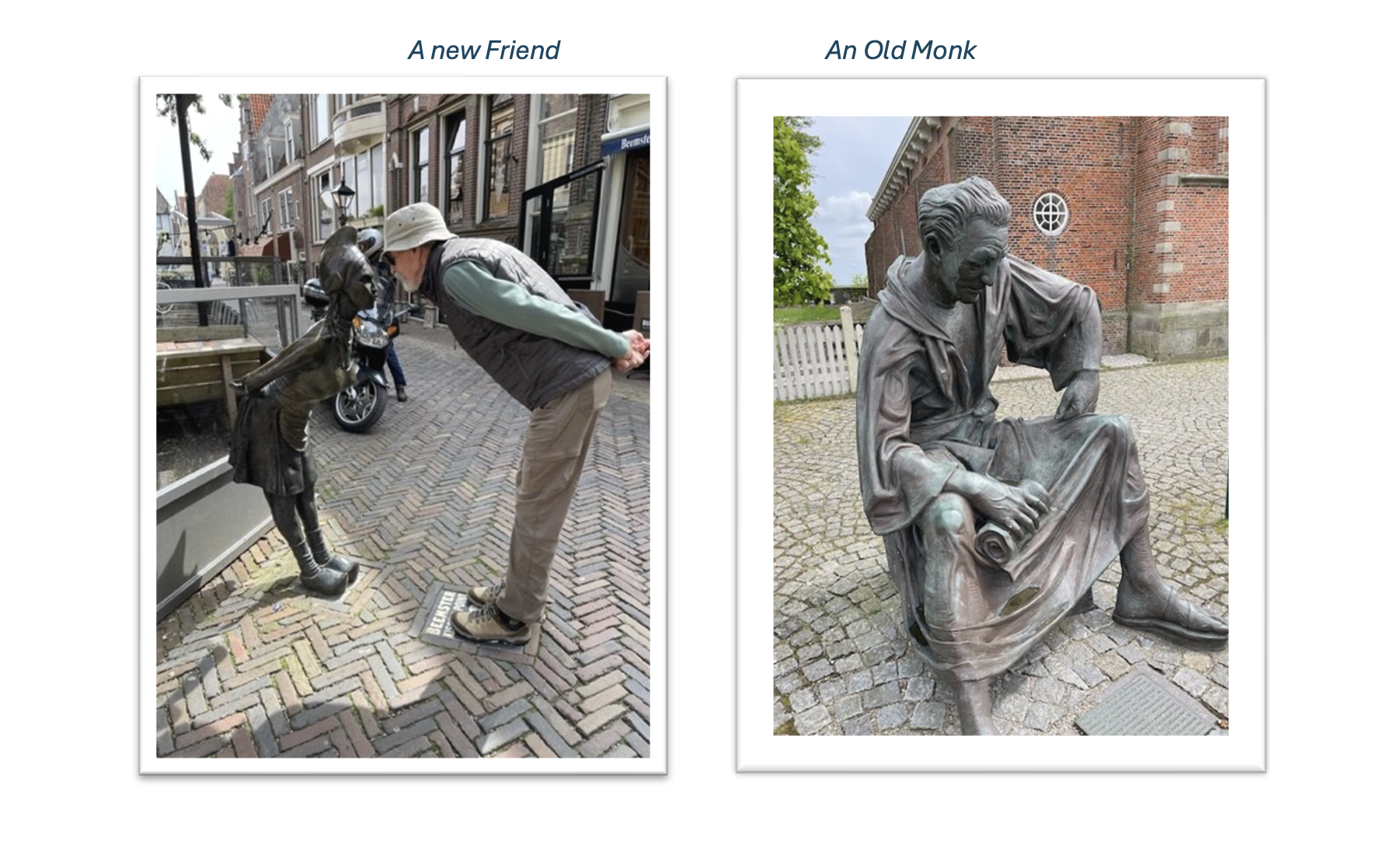
Dutch Sculpture

…more Sculpture

Snippets from the Barge

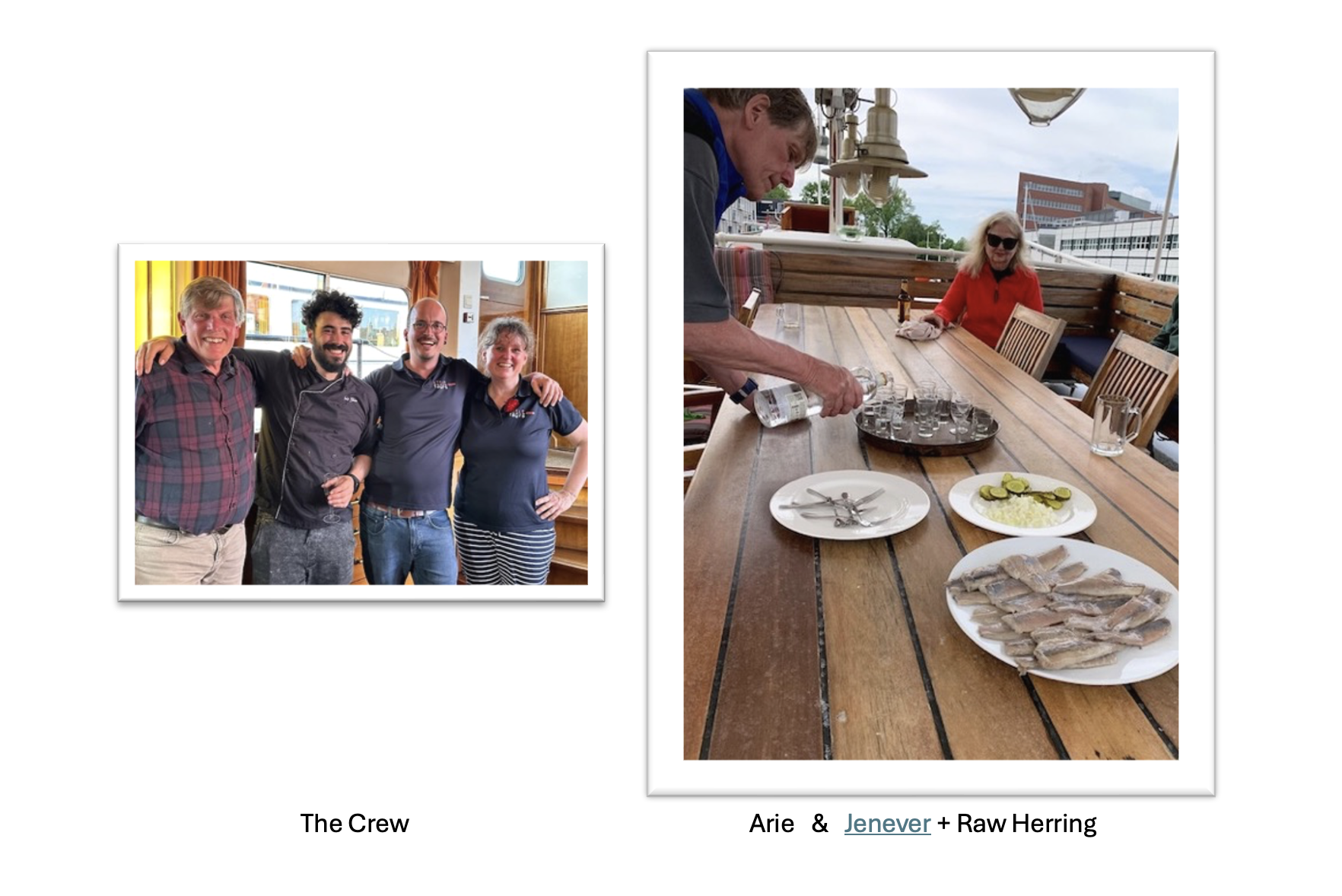
A last Breath of Salty Dutch Air
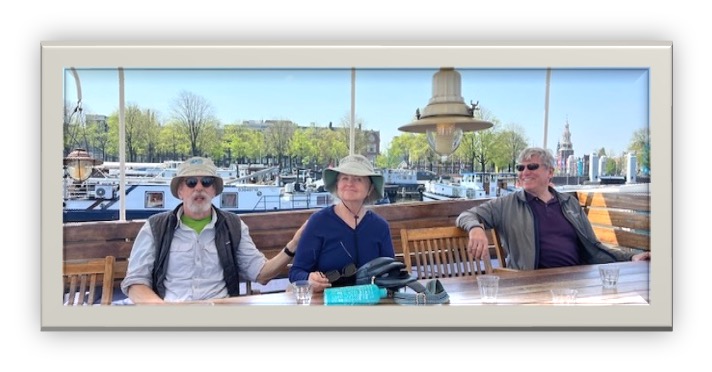
A Research Endeavor: a Catalyst for Reflection
Our previous trips to Italy had been a bike ride with The Bicycle Adventure Club (2012) and (2014) a chance to see Florence (beyond breath-taking), plus a remote resort in southern Italy. (Why is the South always the most unsophisticated part of any country?).
Rome had been merely a city with an airport, the Vatican (yes, I was raised Catholic), and the worst traffic in any disorderly urban bedlam.
This time, Rome was our destination — specifically parts of Rome which are locations within Joy’s new novel, including the Jewish Ghetto with its monumental Tempio Maggiore — The Great Synagogue of Rome.
Built in 1904 (design by Vincenzo Costa and Osvaldo Armanni), its lowest level now contains the Museo Ebraico di Roma — an astonishing collection of scrolls and artifacts.
We did classic tourist hustle and bustle: a tour of the Colosseum; a tour of the Pantheon. They were reminders of excellence in architecture, engineering, and entertaining the deplorables.
From our guest house accommodations (“Remember, this is not a hotel; use the link to activate the door …”) we wandered to extraordinary local restaurants each evening. Yes, Yelp works quite well in Rome!
Not a hotel!

Colosseum [link]

Pantheon [link]

Tourists in Warm Rome, not chilly Netherlands

A long Time Ago …

The Center of the Ghetto Tour
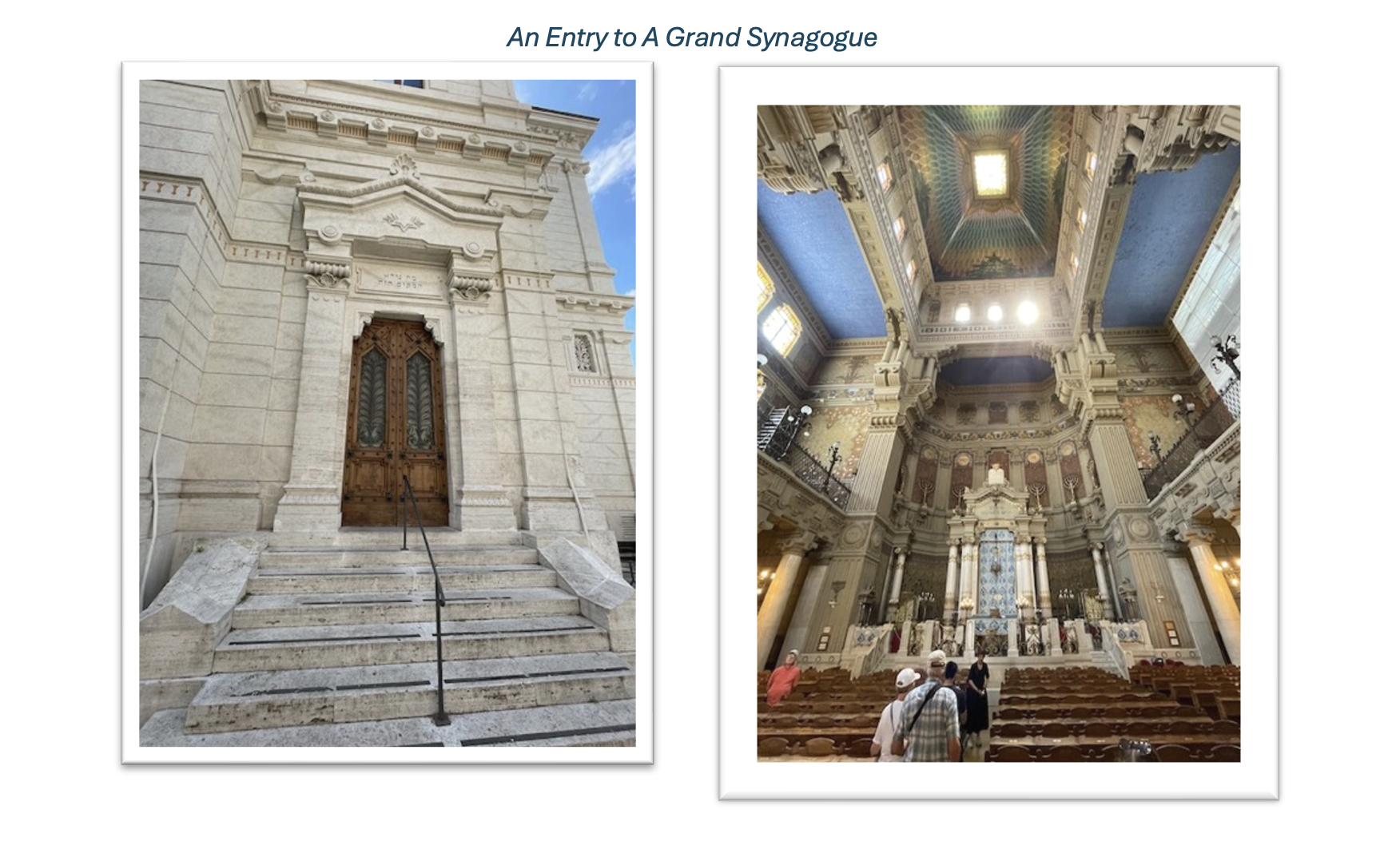

In one small restaurant we could not help but hear snippets of conversation at the next table: a mature woman and a younger man — speaking to the waitress in Italian and in English. But, speaking to each other in neither language. Eventually, we found a way to strike up a conversation and discovered that the young man was the son of the Israeli woman, who was visiting to see how his studies in medical school in Rome were progressing. And, I suspect, to escape the chaos and rancor at home. Of course, their other language was Hebrew. After hearing about Joy’s book, they offered to help arrange a visit to the Great Synagogue. Not necessary, it turned out.
It was not our only contact with Hebrew: after our guided Ghetto tour, we decided to stay and find a place for lunch: “Would you like a menu in English or Hebrew?” the waitress asked (in English). I forget the name of the restaurant, but not the establishment next door — the place selling bagels and baguettes — Ba’Ghetto.
Still contemplating the Resistance Museum in Amsterdam, still fearing the trajectory of current U.S. political drift, the physical reality of the current Ghetto is a stark reminder of what can go horribly wrong in the 21stcentury.
What To Do with Extraordinary Wealth
The burgeoning Roman Empire predates the colonial juggernaut of the Netherlands. And, the degenerations of that once-great power were, undoubtedly, a catalyst for Mussolini’s endeavor to Make Rome Great Again. Instead of merely bolstering the education system and reminding citizens of a time of great architecture, engineering, and colonial domination, he borrowed money from international lenders to: make the trains run on time; clean the accumulated debris from Rome; and use his Fascist military to reconquer the lands of the old empire. His popularity was partly based on restoration of early Roman monuments and housing for urban peasants.
Today, though shorn of their marble façades, both the Colosseum and the Pantheon still stand. However, much of the splendor and civic engagement of the Roman Forum is gone.
The spirit of adventure and death-defying valor are now mostly evident in the tumult of the chaotic traffic.
As my biking sojourns in Europe suggest, the ebb and flow of civilization continues. Some physical monuments endure — some fragments of civilizing mastery remain. However, much has been lost: not the technology, not the distillation of philosophy, not the structure of institutions of learning and governance.
What has been lost is the awareness of the universal application of the Golden Rule. Peace is not merely the absence of war — it is the clear-eyed observation of the essence of the Torah from Rabbi Hillel:
He quoted from Leviticus, saying, “Thou shalt not avenge, nor bear any grudge against the children of thy people, but thou shalt love thy neighbour as thyself.” Hillel then concluded: “That which is hateful unto you, do not do to your neighbor. This is the whole of the Torah; the rest is commentary.”
Celluloid nostalgia can overtake us — in our selfishness, we try to look back to a golden age — and we are filled with sorrow:
A sorrow’s crown of sorrow is remembering happier times.
Our sorrow should be that we have lost Hillel’s wisdom — and like the people of the Netherlands during the occupation, we may be faced with horrific decisions.
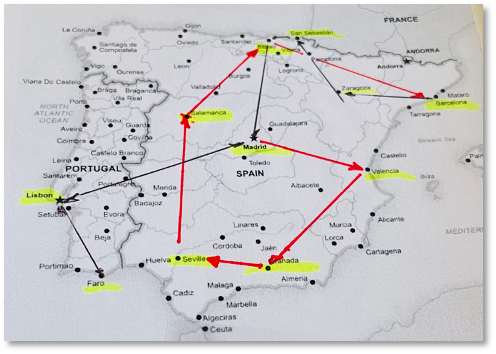





 2wheels2travel